MALDIVES ONLiNE <body><script type="text/javascript"> function setAttributeOnload(object, attribute, val) { if(window.addEventListener) { window.addEventListener('load', function(){ object[attribute] = val; }, false); } else { window.attachEvent('onload', function(){ object[attribute] = val; }); } } </script> <div id="navbar-iframe-container"></div> <script type="text/javascript" src="https://apis.google.com/js/platform.js"></script> <script type="text/javascript"> gapi.load("gapi.iframes:gapi.iframes.style.bubble", function() { if (gapi.iframes && gapi.iframes.getContext) { gapi.iframes.getContext().openChild({ url: 'https://www.blogger.com/navbar/2565417034522534591?origin\x3dhttp://maldives-online.blogspot.com', where: document.getElementById("navbar-iframe-container"), id: "navbar-iframe" }); } }); </script> SCREEN RESOLUTION HAS TO BE 1152*864


<$Saturday, March 17, 2007h5>
<$
Maldivian culture is derived from a number of sources and factors. These include its proximity to Sri Lanka and South India, East Africa, the Malayan Archipelago and the Middle East via its conversion to Islam in the 12th century, and its location as a crossroads in the central Indian Ocean. Maldivians are of Sri Lankan and Southern Indian origin. There are also elements of Arabian, African, and Indonesian origin as well. Maldivian culture shares many aspects with Sri Lanka and Kerala, namely a strong matriarchal tradition.

The music of the Maldives, such as Bodu-Beru (literally "Big Drum"), showcase their African roots, and other cultural activities resemble similarity to those of Arab and North Indian regions.

A unique feature of Maldivian society is a very high divorce rate by either South Asian or Islamic standards, which demonstrates the high degree of autonomy that Maldivian women have over their lives.

The Maldives is an almost exclusively Islamic society. It is common to hear Maldivians refer to their country as a "100 percent Muslim country." But the isolation of Maldives from the historical centers of Islam in the Middle East and Asia has allowed some pre-Islamic beliefs and attitudes to survive.

There is a widespread belief in jinns, or evil spirits. For protection against such evils, people often resort to various charms and spells. The extent of these beliefs has led some observers to identify a magico-religious system parallel to Islam known as fanditha, which provides a more personal way for the islanders to deal with either actual or perceived problems in their lives. However this is a dying tradition that can be seen in only rural areas.

Labels: , , , , , , , ,

<$Friday, March 16, 2007h5>
<$Wednesday, March 14, 2007h5>
<$


Atoll Summary
Administrative name Vaavu Atoll
Atoll name Felidhu Atoll
Location 3° 41' N and 3° 13' N
Letter J
Abbreviation V (ވ)
Capital Felidhoo
Population 2144
No. of Islands 19
Inhabited Islands 5
Atoll Chief Ali Rasheed Abdul Rahman [1]
Inhabited Islands
Felidhoo Fulidhoo Keyodhoo Rakeedhoo Thinadhoo

Labels: , , , , , , ,

<$

Kaafu Atoll is an administrative atoll from the Maldives. This administrative atoll has four natural atolls collectively called the Malé Atoll: (from north to south) Kaashidhoo, Gaafaru, the North Malé Atoll and the South Malé Atoll.

Malé, capital of the Maldives is located within the North Malé atoll.

Atoll Summary
Administrative name Kaafu Atoll
Atoll name Malé Atoll
Location 4°25′N 73°30′ECoordinates: 4°25′N 73°30′E
Letter H
Abbreviation K (ކ)
Capital Thulusdhoo
Population 9886
No. of Islands 107
Inhabited Islands 9
Atoll Chief Mohamed Adam [1]
Inhabited Islands
Dhiffushi Gaafaru Gulhi Guraidhoo Himmafushi Hulhumalé Huraa Kaashidhoo Malé Maafushi Thulusdhoo
Uninhabited Islands
Aarah Akirifushi Asdhoo Baros Biyaadhoo Bodubandos Bodufinolhu Boduhithi Boduhuraa Bolifushi Dhigufinolhu Dhoonidhoo Ehrruh-haa Enboodhoo Enboodhoofinolhu Eriyadhoo Farukolhufushi Feydhoofinolhu Fihalhohi Funadhoo Furan-nafushi Gasfinolhu Giraavaru Girifushi Gulheegaathuhuraa Helengeli Henbadhoo Hulhulé Huraagandu Ihuru Kagi Kalhuhuraa Kandoomaafushi Kanduoih-giri Kanifinolhu Kanuhuraa Kudabandos Kudafinolhu Kudahithi Kudahuraa Lankanfinolhu Lankanfushi Lhohifushi Lhosfushi Maadhoo Madivaru Mahaanaélhihuraa Makunudhoo Makunufushi Maniyafushi Medhufinolhu Meerufenfushi Nakachchaafushi Olhahali Olhuveli Oligandufinolhu Ran-naalhi Rasfari Thanburudhoo Thilafushi Thulhaagiri Vaadhoo Vaagali Vabbinfaru Vabboahuraa Vammaafushi Velassaru Velifaru Veliganduhuraa Vihamanaafushi Villingili Villingilimathidhahuraa Villingilivau Ziyaaraiffushi

Labels: , , , , , , , , , ,

<$


Baa Atoll is an atoll in the Maldives. Situated on the west of the Maldives atoll chain, it consists of 75 islands of which 13 are inhabited with a population of over 11,000 people. The remaining 57 islands are uninhabited, in addition to five islands being developed as resorts.

This administrative atoll consists of two separate natural atolls, namely South Maalhosmadulu Atoll and Goidhoo Atoll (also known as Horsburgh Atoll). The South Maalhosmadulu Atoll is 42km long and 32km wide and consists of 10 inhabited islands.

Baa Atoll is also considered as a good example of the rich biodiversity found in the Maldives, including large mangroves and a unique diversity of fauna, such as the benthic fauna. Furthermore, the ring-shaped reef forms known as faroes in the Baa atoll is a reef structure which is unique to the Maldives.

The southernmost uninhabited island of Olhugiri in the Baa atoll lies 13 km north of Goidhoo Atoll. Olhugiri is well-known for its unique natural vegetation and for providing two of the only perching sites for the Great Frigatebird in the Maldives. Likewise, other marine creatures such as seaturtles and hawksbill turtles can be encountered.

The Fisheries Ministry of the Maldives has banned catching turtles or taking eggs from Olhugiri, which also applies to 11 other islands.

Atoll Summary
Administrative name Baa Atoll
Atoll name Maalhosmadulu
Location 5° 23' N and 4° 49' N
Letter F
Abbreviation B (ބ)
Capital Eydhafushi
Population 11910
No. of Islands 75
Inhabited Islands 13
Atoll Chief - [1]
Inhabited Islands
Dharavandhoo Dhonfanu Eydhafushi Fehendhoo Fulhadhoo Goidhoo Hithaadhoo Kamadhoo Kendhoo Kihaadhoo Kudarikilu Maalhos Thulhaadhoo
Uninhabited Islands
Ahivaffushi, Aidhoo, Anhenunfushi, Bathalaa, Bodufinolhu, Boifushi, Dhakendhoo, Dhandhoo, Dhigufaruvinagandu, Dhunikolhu, Enboodhoo, Fehenfushi, Finolhas, Fonimagoodhoo, Fulhadhoorah kairi finonolhu, Funadhoo, Gaagandufaruhuraa, Gaavillingili, Gemendhoo, Hanifaru, Hanifarurah, Hibalhidhoo, Hirundhoo, Horubadhoo, Hulhudhoo, Innafushi, Kanifusheegaathu finolhu, Kanifushi, Kashidhoogiri, Keyodhoo, Kihaadhufaru, Kihavah-huravalhi, Kudadhoo, Kunfunadhoo, Landaagiraavaru, Lunfares, Maaddoo, Maafushi, Maamaduvvari, Maarikilu, Madhirivaadhoo, Medhufinolhu, Mendhoo, Milaidhoo, Miriandhoo, Muddhoo, Muthaafushi, Nibiligaa, Olhugiri, Thiladhoo, Ufuligiri, Undoodhoo, Vakkaru, Velivarufinolhu, Veyofushee, Vinaneih-faruhuraa, Voavah

Labels: , , , , , , ,

<$Sunday, March 11, 2007h5>
<$
The temperature of Maldives ranges between 24 and 33 °C throughout the year. Although the humidity is relatively high, the constant sea breezes help to keep the air moving. Two seasons dominate Maldives' weather: the dry season associated with the winter northeast monsoon and the rainy season brought by the summer southwest monsoon. The annual rainfall averages 2,540 millimeters in the north and 3,810 millimeters in the south.

The weather in Maldives is affected by the large landmass of the South Asia to the north. The presence of this landmass causes differential heating of land and water. Scientists also cite other factors in the formation of monsoons, including the barrier of the Himalayas on the northern fringe of the South Asia and the sun's northward tilt, which shifts the jet stream north. These factors set off a rush of moisture-rich air from the Indian Ocean over the South Asia, resulting in the southwest monsoon. The hot air that rises over the South Asia during April and May creates low-pressure areas into which the cooler, moisture-bearing winds from the Indian Ocean flow. In Maldives, the wet southwest monsoon lasts from the end of April to the end of October and brings the worst weather with strong winds and storms. In May 1991 violent monsoon winds created tidal waves that damaged thousands of houses and piers, flooded arable land with seawater, and uprooted thousands of fruit trees. The damage caused was estimated at US$30 million.

The shift from the moist southwest monsoon to the dry northeast monsoon over the South Asia occurs during October and November. During this period, the northeast winds contribute to the formation of the northeast monsoon, which reaches Maldives in the beginning of December and lasts until the end of March. However, the weather patterns of Maldives do not always conform to the monsoon patterns of the South Asia. Rain showers over the whole country have been known to persist for up to one week during the midst of the dry season.

Labels: , , , , , , , , , ,

<$


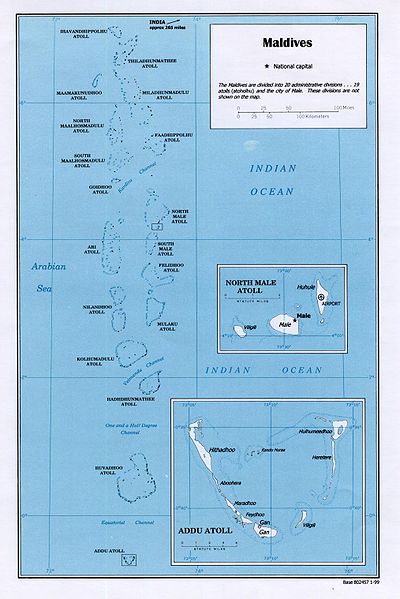
Maldives is a country of South Asia, situated in the Indian Ocean, south-southwest of India. It consists of approximately 1,196 coral islands grouped in a double chain of 27 atolls, spread over roughly 90,000 square kilometers, making this one of the most disparate countries in the world. Composed of live coral reefs and sand bars, the atolls are situated atop a submarine ridge 960 kilometers long that rises abruptly from the depths of the Indian Ocean and runs from north to south. Only near the southern end of this natural coral barricade do two open passages permit safe ship navigation from one side of the Indian Ocean to the other through the territorial waters of Maldives. For administrative purposes the Maldives government organized these atolls into nineteen administrative divisions.

The largest island of Maldives is Fuvammulah, which is a single island and single atoll located in the southern part of the Maldives known as Gnaviyani Atoll in the administrative division. In Addu Atoll the westernmost islands are connected by roads over the reef and the total length of the road is 12 km.

Geographic coordinates: 3°15′N 73°00′E


Physiography

Most atolls consist of a large, ring-shaped coral reef supporting numerous small islands. Islands average only one to two square kilometers in area, and lie between one and 1.5 meters above mean sea level. The highest island is situated at three meters above sea level. Maldives has no hills or rivers. Although some larger atolls are approximately 50 kilometers long from north to south, and 30 kilometers wide from east to west, no individual island is longer than eight kilometers.

Each atoll has approximately five to ten inhabited islands; the uninhabited islands of each atoll number approximately 20 to 60. Several atolls, however, consist of one large, isolated island surrounded by a steep coral beach. The most notable example of this type of atoll is the large island of Fuvammulah situated in the middle of the Equatorial Channel.

The tropical vegetation of Maldives comprises groves of breadfruit trees and coconut palms towering above dense scrub, shrubs, and flowers. The soil is sandy and highly alkaline, and a deficiency in nitrogen, potash, and iron severely limits agricultural potential. Ten percent of the land, or about 26 km², is cultivated with taro, bananas, coconuts, and other fruit. Only the lush island of Fuvammulah produces fruits such as oranges and pineapples partly because the terrain of Fuvammulah is higher than most other islands, leaving the groundwater less subject to seawater penetration. Freshwater floats in a layer, or "lens," above the seawater that permeates the limestone and coral sands of the islands. These lenses are shrinking rapidly on Male and on many islands where there are resorts catering to foreign tourists. Mango trees already have been reported dying on Male because of salt penetration. Most residents of the atolls depend on groundwater or rainwater for drinking purposes. Concerns over global warming and a possible long-term rise in sea level as a result of the melting of polar ice are important issues to the fragile balance between the people and the environment of Maldives in the 1990s.

Labels:


Image Hosted by ImageShack.us


WEATHERForecast: 15-Day Overview
Google

Archives


I NEED A VOCATION Maldives Welcome to Maldives A little bit of Maldives maldives sky map Maldives Part One Maldives Part Two VOCATION IN PARADİSE
Live Flight Information


google adwords reklam Super Bowl 2010 Live