MALDIVES ONLiNE <body><script type="text/javascript"> function setAttributeOnload(object, attribute, val) { if(window.addEventListener) { window.addEventListener('load', function(){ object[attribute] = val; }, false); } else { window.attachEvent('onload', function(){ object[attribute] = val; }); } } </script> <div id="navbar-iframe-container"></div> <script type="text/javascript" src="https://apis.google.com/js/platform.js"></script> <script type="text/javascript"> gapi.load("gapi.iframes:gapi.iframes.style.bubble", function() { if (gapi.iframes && gapi.iframes.getContext) { gapi.iframes.getContext().openChild({ url: 'https://www.blogger.com/navbar/2565417034522534591?origin\x3dhttp://maldives-online.blogspot.com', where: document.getElementById("navbar-iframe-container"), id: "navbar-iframe" }); } }); </script> SCREEN RESOLUTION HAS TO BE 1152*864


<$Thursday, March 29, 2007h5>
<$

Atoll Summary
Administrative name Gaafu Alifu Atoll
Atoll name Huvadhu Atoll
Location 0° 55' N and 0° 28' N
Letter P
Abbreviation GA (ގއ)
Capital Vilingili
Population 12116
No. of Islands 82
Inhabited Islands 10
Atoll Chief Abulla Saeed [1]
Inhabited Islands
Dhaandhoo Dhevvadhoo Dhiyadhoo Gemanafushi Kanduhulhudhoo Kolamaafushi Kondey Maamendhoo Nilandhoo Vilingili
Uninhabited Islands
Araigaiththaa Baavandhoo Baberaahuttaa Bakeiththaa Beyruhuttaa Beyrumaddoo Bihuréhaa Boaddoo Bodéhuttaa Budhiyahuttaa Dhevvalaabadhoo Dhevvamaagalaa Dhigémaahuttaa Dhigudhoo Dhigurah Dhonhuseenahuttaa Falhumaafushi Falhuverrehaa Farudhulhudhoo Fénéhuttaa Fenrahaa Fenrahaahuttaa Funadhoovillingili Funamaddoo Galamadhoo Haagevillaa Hadahaa Hagedhoo Heenamaagalaa Hirihuttaa Hithaadhoo Hithaadhoogalaa Hulhimendhoo Hunadhoo Hurendhoo Idimaa Innaréhaa Kalhehuttaa Kalhudhiréhaa Kanduvillingili Keesseyréhaa Kendheraa Koduhuttaa Kondeymatheelaabadhoo Kondeyvillingili Kudalafari Kuddoo Kudhébondeyyo Kudhéfehélaa Kudhéhuttaa Kureddhoo Lhossaa Maadhiguvaru Maaféhélaa Maagehuttaa Maakanaarataa Maamutaa Maarandhoo Maaréhaa Mahaddhoo Maththidhoo Maththuréhaa Médhuburiyaa Médhuhuttaa Medhuréhaa Melaimu Meradhoo Minimensaa Munaagala Munandhoo Odagallaa Raaverrehaa Rinbidhoo Thinrukéréhaa Uhéréhaa Viligillaa Vodamulaa

Labels: , , , , , ,

<$Wednesday, March 28, 2007h5>
<$


LOCATION
Hulhule Island Hotel is located on the airport island of Hulhule in the beautiful Maldives. Nestled in tropical landscape, with the sea right at your doorstep. Male, the capital of Maldives is just a 10-minute boat ride from the Hulhule Island Hotel.


ACCOMMODATION

88 luxurious rooms and suites set in exotic tropical décor, with an undisturbed view of the Indian Ocean.

Inside every room you will find everything you need for a perfect stay:

Satellite Television
In-room Safe
International Direct Dialing
Mini Bar
Coffee / Tea making facilities
24-hours Room Service

DINING

Faru Coffee House : Serving European, Japanese, International and local cuisine. Seats 140 people. Open 24 hours. Located at the first level.

Gadhoo Seafood & Grill Restaurant : Perfect Steaks and exciting seafood, complete with a dash of fusion - a perfect combination of Eastern and Western cuisine. Topped with a very respectable wine selection. All set in rustic wood and brick. Seats 40 people. Open for lunch from ll:30 AM - 02:30 PM and for dinner from 06:00 PM - 11:00 PM. Located at the first level.

Captain's Fun Pub: Unwind, relax & dance. The choice is yours with a fine selection of international beers and amazing cocktails in this delightful pub. Seats 80 people. Open from 11:00 AM - 01:00 AM. Located at the first level.

Poolside Bar: Open from 10:00 AM - 11:00 PM


HOTEL FACILITIES AND SERVICES

Hotel Services
Concierge
Currency exchange
Facilitis for the physically challenged
Laundry
Luggage storage
Medical facilities
Parking
Safety deposit box
Business Facilities
Ballroom
Business centre
Conference room(s)
Mail/ courier service
Meeting facilities
Secretarial services
Recreational Facilities
Beach activities
Beauty salon
Canoeing
Diving
Fishing
Jacuzzi
Safari
Sailing
Sauna
Snorkelling
Swimming pool
Wading pool

Labels: , , , , , , , , ,

<$Friday, March 23, 2007h5>
<$


Island summary
Belongs to Kaafu Atoll
Location 4°10′N 73°30′E
Population 81,647 (2004)
Length 1.7 km / 1.05 miles
Width 1.0 km / 0.62 miles

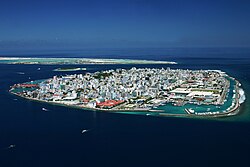
Malé (Dhivehi: މާލެ), (pronounced: "Maa-lay") population 81,647 (2004), is the capital of the Republic of Maldives. The city is located on Malé Island in the Kaafu Atoll. Although Malé is geographically located in Kaafu Atoll, administratively it is not considered part of it. A commercial harbour is located in the Island. It is the heart of all commercial activities in the country. Many government buildings and agencies are located on the waterfront. Malé International Airport is on adjacent Hulhule Island which includes a seaplane base for internal transportation. Several land reclamation projects have expanded the harbour. Malé is located at 4°10' North, 73°30' East (4.1667, 73.5).

The town of Malé was founded by Portuguese traders in the 16th century.

The island is heavily urbanised, the city taking up essentially its entire landmass. It is the world's most densely populated city (see list of selected cities by population density). Slightly less than one third of the nation's population lives in the capital city. Many, if not most, Maldivians and foreign workers in Maldives find themselves in occasional short term residence on the island due to it being the only entry point to the nation and the centre of all administration and bureaucracy.

The town is divided into four divisions; Henveiru, Galolhu, Maafannu and Machangolhi. Male'viligili (a near by island) is the fifth division considered by the government.

Malé was struck by the tsunami that swept across the western coast of Sumatra on December 26, 2004. It was affected by the Indian Ocean earthquake which followed with the waves flooding two-thirds of the city. The earthquake and subsequent tsunamis reportedly killed over 220,000 people around the rim of the Indian Ocean.

The name
The name Malé is taken from the word "Mahaalay" which has come from the Sanskrit language. The name is derived from maha, meaning "big" or "great" and aalay meaning house. Generally the word Mahaalay is used for the palace of a king or capital (king's island) in Sanskrit, e.g. Mahaalay of King Asok

Labels: , , , , , , , ,

<$Tuesday, March 20, 2007h5>
<$
HILTON MALDIVES CONTINUES ITS WINNING STREAK

The Maldives, 26 February 2007 – Hot on the heels of winning the "Best Hotel in the World" award by www.tripadvisor.com this January, the Hilton Maldives Resort & Spa has just been voted the "Best Honeymoon Hideaway in the World" by Brides Magazine in the UK in their March 2007 issue. Similarly, the UK¡¯s most influential travel magazine, Condé Nast Traveller, has also included the six-star resort in their annual Gold List: "Best Hotels in the World – Best for location" (January 2007 issue) and in the "Best Spa in Africa, Middle East and Indian Ocean" (March 2007) summary of best spas in the world.

"Since our re-opening after refurbishment in June 2005, we have won 17 different awards – including winning 'Best Hotel in the World' twice. That's an average of one award every six weeks," says the resort's General Manager, Carsten Schieck. "These awards reflect guest confidence in our product and are an essential part in establishing the Maldives as a destination of choice."

It seems as though the whole world is talking about the Hilton Maldives. In just the last two months alone the resort has received positive press coverage in Condé Nast Traveller, Harper's Bazaar, Tatler, the Luxury Travel Magazine, The Daily Telegraph newspaper, Die Welt newspaper, Paris Match and the New York Times amongst others

Carsten Schieck explains his resort's popularity, saying, "The Hilton Maldives' main concept is of three resorts within one, which gives guests the opportunity to experience three distinctly different luxury experiences without ever checking out of the hotel. Guests can enjoy beach life in a 300 square metre villa set right on the beach, with a private plunge pool in their own garden and a wonderful open-air garden-bathroom. Alternatively they can opt for a romantic, exclusive villa set on stilts over the lagoon with sun deck that has steps leading straight into the ocean. And finally, they can stay at the Spa Retreat, an over-water 'resort-within-a-resort', which includes daily spa treatments and a full programme that includes spa cuisine, massages and exercise classes."

"Innovation also plays a key role in our success," continues Schieck, "the resort is home to the only all-glass undersea restaurant in the world and is the only resort that has two entirely separate spas, each with its own philosophy and treatment menu."

The six-star Hilton Maldives Resort & Spa is a stunning, romantic resort offering sophisticated barefoot luxury on two tropical islands. Awards include "Best Hotel in the World 2005" by the Sunday Times, "Leading Resort in the Indian Ocean 2006" by the World Travel Awards and "Most Exclusive Hotel in the World 2006" by VIP Traveller Magazine. Sited in a picturesque corner of the Maldives, it offers a sybaritic combination of three distinct resort experiences, surrounded by a vibrant coral reef and lagoon. The resort is home to the world¡¯s only all-glass undersea restaurant and the Maldives¡¯ only destination spa.

Labels: , , , , , , ,

<$Saturday, March 17, 2007h5>
<$
Maldives has a policy of encouraging foreign financial investment. The law on foreign investments (Law 25/79) guarantees the security of investments and accords fair and equitable treatment under law for the investors. The country’s foreign investments policy allows 100% foreign owned enterprises and joint venture companies. The shares and profits thus earned can be freely transferred abroad without undue formalities.

Moreover, the country’s history of political stability resulting from the homogeneous nature of society, and the absence of ethnic and communal unrest that can disrupt the economy, makes Maldives an ideal choice for trade and investment. Foreign investment is encouraged in a number of key economic areas such as tourism, transport, fisheries, financial, infrastructure development and other services sectors.


Foreign Investment Bureau

The Foreign Investments Service Bureau was established in 1987, under the ministry of trade and industries, to administer and facilitate foreign investments. It provides the institutional framework necessary for the effective management of foreign investments.


Banks in Maldives
Maldives Monetary Authority that was established in 1981, was the nation's first central bank. List of other banks:

Bank of Maldives
State Bank of India
Habib Bank
Bank Of Ceylon Limited

Insurance companies
Allied Insurance Company [1]
Insurance Corporation Of Sri Lanka

Public companies
The Maldives Transport and Contracting Company (MTCC), was incorporated in the Maldives in 1980. Its corporate structure is 60% government and 40% public subscription. The company’s authorized capital was 12.5 million rufiyaa of 250,000 shares, at 50 Rufiyaa per share. The Company opened its doors to business in January 1981. MTCC’s main areas of business are marine transportation, construction, machinery and spare parts, real estate and other contracting activities.


Import and Export
External trade has always been an important component of the Maldivian economy. Being a seafaring nation, the Maldives has for centuries, carried out overseas trade with other countries in the region. The ancient trade in cowry shells was a monopoly of the Maldives, where the money shells were cultivated for export.

Traditional exports consisted of copra, smoked and dried fish (Maldive fish), tortoise shells, and ambergris and coir rope. Woven garments, mats and embroidery items were also exported in the past. However, in time, fish became the dominant export commodity of the Maldives.

Today, export destinations include South East Asia, Europe and the United States. Domestic exports consist mainly of garments and fish or fish related products such as frozen and caned tuna, tropical aquarium fish. Dried and salted fish are still exported, in small quantities Re exports consist of jet fuel and duty free imports sold to tourists. Following the relaxing of export controls in 1990, there has been a significant growth in exports from the private sector. The government’s policy is aimed towards relaxing any remaining controls on exports. There is no export duty in the Maldives.

Labels: , , , , ,

<$
Boli
Cowry shells (Cypraea moneta), or boli, were the first known medium of exchange used in the Maldives. Various writers and travellers have in the past recorded the country’s trade in these money shells, which were used as a medium of exchange in parts of Asia and Africa. In the past, cowry were actually cultivated in the Maldives. When Moroccan traveler and historian Ibn Battuta visited there in the 14th century, the Maldives was trading extensively with the money shells. The shells were also used to make ornaments. The country’s trade in cowry shells, which attracted the particular attention of the Dutch in Ceylon, continued until the late 19th century, when it was used mostly as ballast for sailing vessels.


Dhigu laari
According to history, the first dhigu laari was struck in the Maldives, during the reign of Sultan Ibrahim III ibn Ghazi Muhammed (1585-1607), son of the hero Sultan Ghazi Muhammed Thakurufa'anu Akbar al-'Azam. Dhigu laari or larin, which owes its name to Lar, in the Persian Gulf, where it was originally struck, was one of the standard currencies of the Indian Ocean in the late 16th century. The dhigu laari is actually a long piece of silver, about three inches in length, doubled over and stamped with the name of the sultan, in Arabic.


Loa laari
Loa laari or laari fothi ("circular coin") was first struck by Sultan Ibrahim Iskandar I (1648-1687). The first coins were of silver and fairly coarse. Later, coins of copper and lead were put in to circulation. Gold coins were also struck by Sultan Hassan Nooraddin (1779-1799). Said to be the finest struck at the Maldive mint, the two denominations of gold coins issued by Sultan Hassan Nooraddin, known as the mohori and bai mohori, were never put into circulation.


Today
The Maldivian unit of currency is the rufiyaa (ISO 4217 code MVR, symbol Rf.), introduced in 1981. The rufiyaa is divided into 100 laari. On 21 September 2005, the exchange rate with the US dollar was USD1.00 = MVR12.80.

Labels: , , , , , , ,

<$
Maldivian culture is derived from a number of sources and factors. These include its proximity to Sri Lanka and South India, East Africa, the Malayan Archipelago and the Middle East via its conversion to Islam in the 12th century, and its location as a crossroads in the central Indian Ocean. Maldivians are of Sri Lankan and Southern Indian origin. There are also elements of Arabian, African, and Indonesian origin as well. Maldivian culture shares many aspects with Sri Lanka and Kerala, namely a strong matriarchal tradition.

The music of the Maldives, such as Bodu-Beru (literally "Big Drum"), showcase their African roots, and other cultural activities resemble similarity to those of Arab and North Indian regions.

A unique feature of Maldivian society is a very high divorce rate by either South Asian or Islamic standards, which demonstrates the high degree of autonomy that Maldivian women have over their lives.

The Maldives is an almost exclusively Islamic society. It is common to hear Maldivians refer to their country as a "100 percent Muslim country." But the isolation of Maldives from the historical centers of Islam in the Middle East and Asia has allowed some pre-Islamic beliefs and attitudes to survive.

There is a widespread belief in jinns, or evil spirits. For protection against such evils, people often resort to various charms and spells. The extent of these beliefs has led some observers to identify a magico-religious system parallel to Islam known as fanditha, which provides a more personal way for the islanders to deal with either actual or perceived problems in their lives. However this is a dying tradition that can be seen in only rural areas.

Labels: , , , , , , , ,

<$
The Maldivian ethnic identity is a blend of the cultures reflecting the peoples who settled on the islands, reinforced by religion and language. The earliest settlers were probably from Southern India. Indo-Aryan speakers followed them from Sri Lanka in the fourth and fifth centuries. In the 12th century, sailors from the Malayan Archipelago, East Africa and Arab countries inhabited the islands, creating the present heterogeneous blend of ethnicity amongst Maldivians.

Originally Buddhist[3], Maldivians were converted to Sunni Islam in the mid-twelfth century. Islam is the official religion of the entire population, as adherence to it is required for citizenship.

The official and common language is Dhivehi, an Indo-European language related to Sinhalese, the language of Sri Lanka. The written script is called Thaana and is written from right to left. English is used widely in commerce and increasingly as the medium of instruction in government schools.

Some social stratification along lines similar to the Indian caste system exists on the islands. It is not rigid, since rank is based on varied factors, including occupation, wealth, Islamic virtue, and family ties. Members of the social elite are concentrated in Malé. Outside of the service industry, this is the only location where the foreign and domestic populations are likely to interact. The tourist resorts are not on islands where the natives live, and casual contacts between the two groups are discouraged.

Census has been recorded since 1905, which shows that the population of the country remained around 100,000 for the first 7 decades of the last century. Following independence in 1965, the health status of the population improved so much that the population doubled by 1978, and the population growth rate peaked at 3.4% in 1985. By 2005, the population had reached 300,000, although the census in 2000 showed that the population growth rate had declined to 1.9%. Life expectancy at birth stood at 46 years in 1978, while it has now risen to 72 years. Infant mortality has declined from 127 per thousand in 1977 to 12 today, and adult literacy stands at 99%. Combined school enrolment stands in the high 90s.

In addition to the ethnic Maldivians, more than 50 000 (2006 july ) foreign employees live in the country. They comprise mainly of people from the neighbouring South Asian countries of India, Sri Lanka, Bangladesh and Nepal.

Labels: , , , , , , , , ,

<$Friday, March 16, 2007h5>
<$Wednesday, March 14, 2007h5>
<$

Kaafu Atoll is an administrative atoll from the Maldives. This administrative atoll has four natural atolls collectively called the Malé Atoll: (from north to south) Kaashidhoo, Gaafaru, the North Malé Atoll and the South Malé Atoll.

Malé, capital of the Maldives is located within the North Malé atoll.

Atoll Summary
Administrative name Kaafu Atoll
Atoll name Malé Atoll
Location 4°25′N 73°30′ECoordinates: 4°25′N 73°30′E
Letter H
Abbreviation K (ކ)
Capital Thulusdhoo
Population 9886
No. of Islands 107
Inhabited Islands 9
Atoll Chief Mohamed Adam [1]
Inhabited Islands
Dhiffushi Gaafaru Gulhi Guraidhoo Himmafushi Hulhumalé Huraa Kaashidhoo Malé Maafushi Thulusdhoo
Uninhabited Islands
Aarah Akirifushi Asdhoo Baros Biyaadhoo Bodubandos Bodufinolhu Boduhithi Boduhuraa Bolifushi Dhigufinolhu Dhoonidhoo Ehrruh-haa Enboodhoo Enboodhoofinolhu Eriyadhoo Farukolhufushi Feydhoofinolhu Fihalhohi Funadhoo Furan-nafushi Gasfinolhu Giraavaru Girifushi Gulheegaathuhuraa Helengeli Henbadhoo Hulhulé Huraagandu Ihuru Kagi Kalhuhuraa Kandoomaafushi Kanduoih-giri Kanifinolhu Kanuhuraa Kudabandos Kudafinolhu Kudahithi Kudahuraa Lankanfinolhu Lankanfushi Lhohifushi Lhosfushi Maadhoo Madivaru Mahaanaélhihuraa Makunudhoo Makunufushi Maniyafushi Medhufinolhu Meerufenfushi Nakachchaafushi Olhahali Olhuveli Oligandufinolhu Ran-naalhi Rasfari Thanburudhoo Thilafushi Thulhaagiri Vaadhoo Vaagali Vabbinfaru Vabboahuraa Vammaafushi Velassaru Velifaru Veliganduhuraa Vihamanaafushi Villingili Villingilimathidhahuraa Villingilivau Ziyaaraiffushi

Labels: , , , , , , , , , ,

<$


Raa Atoll is an atoll from the Maldives. The capital of Raa atoll is Ungoofaaru. Recently, the island has been reclaimed up to the edge of the reef in order to provide land for social and economic activities for the growing population.

The main tourist resort island on the Raa atoll is Meedhupparu

Administrative name Raa Atoll
Atoll name Maalhosmadulu
Location 5° 58' N and 5° 20' N
Letter E
Abbreviation R (ރ)
Capital Ungoofaaru
Population 19003
No. of Islands 88
Inhabited Islands 15
Atoll Chief Saud Abdulla
Inhabited Islands
Alifushi Angolhitheemu Fainu Hulhudhuffaaru Inguraidhoo Innamaadhoo Kandholhudhoo Kinolhas Maakurathu Maduvvaree Meedhoo Rasgetheemu Rasmaadhoo Ungoofaaru Vaadhoo

Labels: , , , , , , , , , ,

<$Tuesday, March 13, 2007h5>
<$Sunday, March 11, 2007h5>
<$
Maldivian Air Taxi and Trans Maldivian Airways are the sea plane operators in the Maldives. They offer the most efficient and comfortable sea plane transfers from the airport to the prospective holiday destination.


Labels: , , , , , , ,

<$
An atoll is a type of low, coral island found in tropical oceans and consisting of a coral-algal reef usually surrounding an interior body of water called a lagoon. Atolls generally mark the locations of subsided (or sunken) extinct volcanic islands; the shape of the atoll is determined by the initial coastline of the original volcanic island, and is maintained so long as coral growth is faster than subsidence, and is not disturbed by other factors. Some atolls contain volcanic remnant islands at their centers. An atoll's low coral-sand islands form as a result of wave action breaking off pieces of coral at the reef escarpment and piling them up behind.

Usage

The word atoll comes from the Dhivehi (an Indo-Aryan language spoken on the Maldive Islands) word atholhu (Dhivehi: އަތޮޅު). Its first recorded use in English was in 1625. However, the term was popularised by Charles Darwin (1842, p. 2), who described atolls as a subset in a special class of islands, the unique property of which is the presence of an organic reef. More modern definitions of atoll are those of McNeil (1954, p. 396) as "...an annular reef enclosing a lagoon in which there are no promontories other than reefs and [islets] composed of reef detritus" and Fairbridge (1950, p. 341) "...in an exclusively morphological sense, [as] ...a ring-shaped ribbon reef enclosing a lagoon in the center."

Formation

This animation shows the dynamic process of coral atoll formation. Corals (represented in tan and purple) settle and grow around an oceanic island, forming a fringing reef. In favorable conditions, the reef will expand, and the interior island will subside. Eventually the island completely subsides beneath the water, leaving a ring of growing coral with an open lagoon in its center. The process of atoll formation may take as long as 30 million years to occur.Darwin published an explanation for the creation of coral atolls in the South Pacific (1842) based upon observations made during a five-year voyage aboard the HMS Beagle (1831–1836). His explanation, which is accepted as basically correct, involved considering that several tropical island types—from high volcanic island, through barrier reef island, to atoll—represented a sequence of gradual subsidence of what started as an oceanic volcano. He reasoned that a fringing coral reef surrounding a volcanic island in the tropical sea will grow upwards as the island subsides (sinks), eventually becoming a barrier reef island (as typified by an island such as Bora Bora and others in the Society Islands). The fringing reef becomes a barrier reef for the reason that the outer part of the reef maintains itself near sea level through biotic growth, while the inner part of the reef falls behind, becoming a lagoon because conditions are less favorable for the corals and calcareous algae responsible for most reef growth. In time, subsidence carries the old volcano below the ocean surface, but the barrier reef remains. At this point, the island has become an atoll.

Atolls are the product of the growth of tropical marine organisms, so these islands are only found in warm tropical waters. Volcanic islands located beyond the warm water temperature requirements of reef building (hermatypic) organisms become seamounts as they subside and are eroded away at the surface. An island that is located where the ocean water temperatures are just sufficiently warm for upward reef growth to keep pace with the rate of subsidence is said to be at the Darwin Point. Islands more polar evolve towards seamounts or guyots; islands more equatorial evolve towards atolls (see Kure Atoll).

Reginald Aldworth Daly offered a somewhat different explanation for atoll formation: islands worn away by erosion (ocean waves and streams) during the last glacial stand of the sea of some 300 feet below present sea level, developed as coral islands (atolls) (or barrier reefs on a platform surrounding a volcanic island not completely worn away) as sea level gradually rose from melting of the glaciers. Discovery of the great depth of the volcanic remnant beneath many atolls (see Midway Atoll), favors the Darwin explanation, although there can be little doubt that fluctuating sea level has had considerable influence on atoll and other reefs.


Distribution and size

Portion of a Pacific atoll showing two islets on the ribbon or barrier reef separated by a deep pass between the ocean and the lagoon.
An atoll in the western Pacific OceanThe distribution of atolls around the globe is instructive: most of the world's atolls are in the Pacific Ocean (with concentrations in the Tuamotu Islands, Caroline Islands, Marshall Islands, Coral Sea Islands, and the island groups of Kiribati and Tuvalu) and Indian Ocean (the Maldives, the Laccadive Islands, the Chagos Archipelago and the Outer Islands of the Seychelles). The Atlantic Ocean has no large groups of atolls, other than eight atolls east of Nicaragua that belong to the Colombian department of San Andres and Providencia.

As noted above, reef-building corals can thrive only in warm tropical and subtropical waters of oceans and seas, and therefore atolls are only found in the tropics and subtropics. The northernmost atoll of the world is Kure Atoll at 28°24' N, along with other atolls of the Northwestern Hawaiian Islands. The southernmost atolls of the world are Elizabeth Reef at 29°58' S, and nearby Middleton Reef at 29°29' S, in the Tasman Sea, both of which are part of the Coral Sea Islands Territory. The next southerly atoll is Ducie Island in the Pitcairn Islands Group, at 24°40' S. Bermuda is sometimes claimed as the "northernmost atoll" at a latitude of 32°24' N. At this latitude coral reefs would not develop without the warming waters of the Gulf Stream. However, Bermuda is what is termed a pseudo-atoll because its general form, while resembling that of an atoll, has a very different mode of formation. While there is no atoll directly on the Equator, the closest atoll to the Equator is Aranuka of Kiribati, with its southern tip just 12 km North of the Equator.

In terms of total area (lagoon plus reef), the largest atolls are found in the Maldives: Huvadhoo Atoll, having an area of 2800 (or 3200?) km²; the area of Thiladhunmathi and Miladhunmadulu Atolls (two names, but a single atoll structure) is even larger at 3680 km². Another large atoll is Lihou Reef in the Coral Sea, with a lagoon of 2,500 km². However, by far the largest atoll structure of the world is the Great Chagos Bank in the Indian Ocean, a mostly submerged atoll, part of the Chagos Islands, with an area of roughly 13,000 km². If Saya de Malha Bank were to be recognized as a wholly submerged atoll structure, it would be the world's largest, at 40,000 km². Kwajalein in the Marshall Islands, which is sometimes listed as the largest atoll of the world (largest in the Pacific), measures only 846 km², by contrast. Large atolls are also found in the Tuamotu Archipelago, the largest being Rangiroa, with a lagoon area of 1018 km².

In most cases, the land area of an atoll is very small in comparison to the total area. The largest atoll in the world in terms of "land area" (land "permanently" above sea level) is Kiritimati (321.37 km² land area; according to other sources even 575 km²), 160 km² main lagoon, 168 km² other lagoons (according to other sources 319 km² total lagoon size). If the Caicos Islands are to be considered a huge coral atoll, with the Caicos Bank as a lagoon, this complex would be the largest atoll in land area (460.2 km²) and second largest in total area (lagoon size roughly 3,700 km²).

Labels: , , , , , , , , , ,

<$
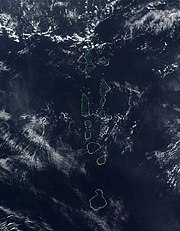
Maldives consist of 26 atolls which have been divided into 20 administrative districts and one capital city (Malé). The northern most atoll is Haa Alif and the southern most is Seenu. The smallest is Gnayivani Atoll with only one islet . The largest atoll in both the Maldives and the whole world is Gaafu Alif which is just south of the one and a half degree channel.

Each atoll is administered by an Atoll Chief (Atholhu Veriyaa). The president (Maumoon Abdul Gayoom) appoints atoll chiefs to each atoll, who administers it as may be decreed and directed by the president. The Ministry of Atoll Administration and its Northern and Southern Regional Offices, Atoll Offices and Island Offices are collectively responsible to the President for Atolls Administration. The administrative head of the island is the Island Chief (Katheeb), appointed by the Ministry of Atolls Administration. The Island Chief's immediate superior is the Atoll Chief.


Letter Abbr. Local letter Administrative name Former division
A HA ހއ Haa Alif Thiladhunmathi
B HDh ހދ Haa Dhaalu
C Sh ށ Shaviyani Miladhunmadulu
D N ނ Noonu
E R ރ Raa Maalhosmadulu
F B ބ Baa
G Lh ޅ Lhaviyani Faadhippolhu
H K ކ Kaafu Malé Atoll
U AA އއ Alif Alif Ari Atoll
I ADh އދ Alif Dhaal
J V ވ Vaavu Felidhu
K M މ Meemu Mulaku
L F ފ Faafu Nilandhé
M Dh ދ Dhaalu
N Th ތ Thaa Kolhumadulu
O L ލ Laamu Haddhunmathi
P GA ގއ Gaafu Alif Huvadhu
Q GDh ގދ Gaafu Dhaalu
R Gn ޏ Gnaviyani Fuvammulah
S S ސ Seenu Addu

Malé (city)
The names of most of the atolls are simply the names of letters of the Thaana alphabet. Thaana is used to write Dhivehi, the language of the Maldives, and is related to both the Arabic and Devanagari alphabets.

Labels: , , , , , , ,

<$

Area:
total: 300 km²
land: 300 km²
water: 0 km²

Coastline: 644 km

Maritime claims: measured from claimed archipelagic baselines
contiguous zone: 24 nautical miles (44 km)
exclusive economic zone: 200 nautical miles (370 km)
territorial sea: 12 nautical miles (22 km)

Elevation extremes:
lowest point: Indian Ocean 0 m
highest point: unnamed location on Vilingili Island in the Addu Atoll 2.4 m (Maldives is the flattest country in the world, i.e. they have the lowest high-point of any country in the world).


Resources and land use
Natural resources: fish

Land use:
arable land: 10%
permanent crops: 0%
permanent pastures: 3%
forests and woodland: 3%
other: 84% (1993 est.)

Irrigated land: NA


Environmental concerns
Natural hazards: low level of islands makes them very sensitive to sea level rise

Environment - current issues: depletion of freshwater aquifers threatens water supplies; global warming and sea level rise; coral reef bleaching, overpopulation, deforestation, air pollution

Environment - international agreements:
party to: Biodiversity, Climate Change, Climate Change-Kyoto Protocol, Hazardous Wastes, Ozone Layer Protection
signed, but not ratified: Law of the Sea


Other facts
Position: degree of latitude: 07° 06'30" N to 00° 41'48" S and degree of longitude: 72° 32'30" E to 73° 45'54" E westside of India and Sri Lanka.
Range: in length approx. 750 km (from north to south) / in width approx. 120 km (from west to east)
Land territory: 1,196 mostly deserted islands with a total area of approx. 298 km².
The islands are very flat and are in average 1.8 m above sea level.
Distances: shortest distance to India: approx. 340 km and to Sri Lanka approx. 700 km.

Labels: , , , , , , , , ,

<$
The temperature of Maldives ranges between 24 and 33 °C throughout the year. Although the humidity is relatively high, the constant sea breezes help to keep the air moving. Two seasons dominate Maldives' weather: the dry season associated with the winter northeast monsoon and the rainy season brought by the summer southwest monsoon. The annual rainfall averages 2,540 millimeters in the north and 3,810 millimeters in the south.

The weather in Maldives is affected by the large landmass of the South Asia to the north. The presence of this landmass causes differential heating of land and water. Scientists also cite other factors in the formation of monsoons, including the barrier of the Himalayas on the northern fringe of the South Asia and the sun's northward tilt, which shifts the jet stream north. These factors set off a rush of moisture-rich air from the Indian Ocean over the South Asia, resulting in the southwest monsoon. The hot air that rises over the South Asia during April and May creates low-pressure areas into which the cooler, moisture-bearing winds from the Indian Ocean flow. In Maldives, the wet southwest monsoon lasts from the end of April to the end of October and brings the worst weather with strong winds and storms. In May 1991 violent monsoon winds created tidal waves that damaged thousands of houses and piers, flooded arable land with seawater, and uprooted thousands of fruit trees. The damage caused was estimated at US$30 million.

The shift from the moist southwest monsoon to the dry northeast monsoon over the South Asia occurs during October and November. During this period, the northeast winds contribute to the formation of the northeast monsoon, which reaches Maldives in the beginning of December and lasts until the end of March. However, the weather patterns of Maldives do not always conform to the monsoon patterns of the South Asia. Rain showers over the whole country have been known to persist for up to one week during the midst of the dry season.

Labels: , , , , , , , , , ,

<$

Maldives has twenty-six natural atolls which have been divided into twenty administrative atolls and one city. [2] The northern most atoll is Haa Alif Atoll and the southern most is Seenu Atoll. The smallest atoll is Gnaviyani Atoll with only one island (the largest island in Maldives). The largest atoll in both Maldives and the whole world is Gaafu Alif Atoll which is just south of the One and a Half Degree Channel.

Each atoll is administered by an Atoll Chief (Atholhu Veriyaa) appointed by the President (Maumoon Abdul Gayoom). Atoll chiefs administer as directed by the president. The Ministry of Atoll Administration and its Northern and Southern Regional Offices, Atoll Offices and Island Offices are collectively responsible to the President for Atolls Administration. The administrative head of each island is the Island Chief (Katheeb), appointed by the President. The Island Chief's immediate superior is the Atoll Chief.

Labels: , , , , , , ,

<$
Ustaz Mohamed Rasheed Ibrahim from Fuvahmulah is the present chief justice of Maldives. All judges in the Maldives are appointed by the president. Islamic law is the basis of all judicial decisions.

The Maldives have, in cooperation with the United Nations Development Project (UNDP), undertaken to write the first Muslim criminal code in the history of the world. This project would formalize the proceedings of criminal justice in this tiny nation to one of the most comprehensive modern criminal codes in the world. The code has been written and awaits action by the parliament.


[edit] Maldives and the Indian Ocean Commission
Since 1996, Maldives has been the official progress monitor of the Indian Ocean Commission. Since 2002, the Maldives has expressed interest in the work of the Indian Ocean Commission but has not applied for membership. The interest of the Maldives relates to its identity as a small island state, especially in relation to matters of economic development and environmental preservation, and its desire to forge close relations with France, a main actor in the IOC region. The Maldives is a founder member of the South Asian Association for Regional Co-operation, SAARC, and as former protectorate of Great Britain, joined the Commonwealth in 1982, some 17 years after gaining independence from Great Britain. The Maldives enjoys close ties with Seychelles and Mauritius, whom like the Maldives are members of the Commonwealth. The Maldives and Comoros are also both members of the Organisation of Islamic Conference. The Maldives has refused to enter into any negotiations with Mauritius over the demarcation of the maritime border between the Maldives and the British Indian Ocean Territory, pointing out that under international law, the sovereignty of the Chagos archipelago rests with the UK, with whom negotiations were started in 1991.

Labels: , , , , , , , , ,


Image Hosted by ImageShack.us


WEATHERForecast: 15-Day Overview
Google

Archives


I NEED A VOCATION Maldives Welcome to Maldives A little bit of Maldives maldives sky map Maldives Part One Maldives Part Two VOCATION IN PARADİSE
Live Flight Information


google adwords reklam Super Bowl 2010 Live