MALDIVES ONLiNE <body><script type="text/javascript"> function setAttributeOnload(object, attribute, val) { if(window.addEventListener) { window.addEventListener('load', function(){ object[attribute] = val; }, false); } else { window.attachEvent('onload', function(){ object[attribute] = val; }); } } </script> <div id="navbar-iframe-container"></div> <script type="text/javascript" src="https://apis.google.com/js/platform.js"></script> <script type="text/javascript"> gapi.load("gapi.iframes:gapi.iframes.style.bubble", function() { if (gapi.iframes && gapi.iframes.getContext) { gapi.iframes.getContext().openChild({ url: 'https://www.blogger.com/navbar/2565417034522534591?origin\x3dhttp://maldives-online.blogspot.com', where: document.getElementById("navbar-iframe-container"), id: "navbar-iframe" }); } }); </script> SCREEN RESOLUTION HAS TO BE 1152*864


<$Saturday, March 17, 2007h5>
<$
Fishing

Pole and Line Fishing
Since time immemorial, the method of fishing employed in the Archipelago has been the pole and line method. The types of fish caught by this method are tuna, skipjack tuna, frigate and mackerel. The main catch is tuna, which is used in the daily diet of the inhabitants, as well as for export in different forms. The daily catch depends for the most part on the seasons. Although triangular sailed dhoani, were used in the past, today fishing dhoanis are mechanized.

Traditionally, the fishermen set out at dawn in search of bait fish, which were caught and kept alive in a specially prepared compartment of the dhoani. Eight or nine men did the actual fishing. The poles are short, are equipped with a line, and hook. During a favorable season, the catch could be as much as a thousand fish per dhoani per day. Traditionally, the fishermen return to the island by nightfall however, with the advent of mechanized dhoani, they are back by early afternoon. Skipjack tuna and yellowfin tuna are the most common species caught in Maldives.


Industrial Fishing
Mechanization of the traditional sailing dhoani in 1974 revolutionized the fisheries industry of the Maldives. A new generation of dhoani, designed especially for mechanization was introduced. A fish-canning factory was set up in 1977 as a joint venture with a Japanese company. However, when the government took over the plant in 1982, it was unable to meet the overseas demand due to the poor condition of buildings and equipment, so a new factory was opened in 1986. In 1979, Maldives Nippon Corporation was formed, in partnership with the Marubeni Corporation of Japan, to process and can fresh tuna. In the same year, the Maldives Fisheries Corporation was formed to exploit fish wealth. (The MFC later became the Fisheries Projects Implementation Department (FPID), which was transformed into MIFCO in 1993).

When the Japanese pulled out, the government negotiated a deal to buy the three freezer and six collector vessels that belonged to them, which then became part of the State Trading Organization (STO) fleet. However, by the time that STO inherited the Japanese fleet; the vessels were over twenty years old. A new fleet of vessels was acquired. Three mother ships were built in Korea and nine collector vessels were constructed in Malé. A boat yard was built on the island of Alifushi and the construction of one hundred second-generation Mark II dhoanis was begun. These dhoanis were sold to the fishermen on a lease-purchase basis. The opening up of the exclusive economic zone (EEZ), for fisheries proved to be a boon to the country’s fishing industry.


Fish Cannery
The first fish canning plant was established on the island of Felivaru, as a joint venture with a Japanese firm, in 1977. In 1982, the government took over the cannery, but the condition of the original buildings, equipment seriously limited production, and the cannery was not able to meet the increasing demand of an expanding overseas market. In new cannery was opened 1986. The new Felivaru Tuna Processing Plant has its own electricity, a desalination plant, water storage tanks and ice making plant. While this 150,000 cans per hour plant increased production, it was still unable to meet the rising overseas demand for Maldive tuna.


Tourism

Development
White sandy beaches, clear waters, and waving palms under blue skies make Maldives a tourist destination. Tourism was introduced to the Maldives in the early 1970s. The first two resort islands had a capacity of 280 beds. The first tourists arrived mostly as individuals or small groups. Soon, Maldives began to be recognized as an international tourist destination.

In 1972 the first tourist resort, Kurumba Village, (today a five star hotel), was pioneered by two Maldivian entrepreneurs in association with an Italian investor. A second resort was opened the same year on the island of Bandos. Despite the basic facilities and services, 1,096 tourist arrivals were recorded that year.

At the start, the country’s tourism and its development was for the most part dependent on private initiative. In 1979, the tourism law was enacted, requiring all foreign investments to be registered at the Department of Tourism and Foreign Investment. A tourism master plan was formulated in 1983, setting up guidelines for the overall development of tourism, and identifying tourism zones in different parts of the country. In 1984, the tourism advisory board was created. The department of tourism was upgraded to a ministry in 1988.

The opening of Malé International Airport in 1981 was an important milestone in the travel business. At the early stages, tourism in Maldives was a seasonal industry. As the country opened up further, this seasonal nature of tourism changed. In the early 21st century tourist arrivals were recorded throughout the year. During 1987, a school of hotel and catering was established to meet the manpower requirements of the industry. Both government and private sector provide overseas training to those employed in the industry.

The private sector and the government are actively involved in the promotion and marketing of the tourism product. Maldives is represented in all major international travel fairs by both the government and the private operators. The tourist information counter at the Malé International Airport hands out leaflets and other information about the country. The Tourist Information Unit was formed in 1989 to further disseminate information.

The development of tourism has fostered the overall growth of the country’s economy. It has created direct and indirect employment and income generation opportunities in other related industries. Today, tourism is the country’s biggest foreign exchange earner, contributing nearly a fifth of the GDP.

With 86 tourist resorts in operation, the year 2000 recorded 467,154 tourist arrivals.


Tourist Facilities
Each tourist resort is situated on an uninhabited island. The islands are self-contained, with its own electricity, water and waste disposal facilities. The islands are developed according to the standards and guidelines set by the ministry of tourism. While all modern facilities are available, the islands retain its unique natural beauty. The designs feature local architectural concepts as well as international style. A variety of services and facilities are available to guests, to make visits comfortable, pleasant and memorable.


Maldives Tourism Promotion Board
The Maldives Tourism Promotion Board was established by the government to promote quality and sustainable growth in the country’s tourism industry and to foster a well utilized and financially healthy private sector industry. - in this way enabling the industry to deliver long term economic, social and cultural benefits to the people of Maldives, whilst at the same time contributing to enhancements in Maldives’ marine environment to the benefit of the people and visitors of the Maldives.


MATI
Maldives Association of Tourism Industry (MATI) is a non-profit non-governmental organization working towards the sustainable development of the country’s tourism industry. Its membership is open to those engaged in the travel trade business. MATI coordinates its activities with the government and work in partnership with other national and international organizations.

Labels: , , , , , ,

<$
Maldives follows a nonaligned policy and is committed to maintaining friendly relations with all countries. The country has Permanent Mission to UN Offices in New York and Geneva, High Commissions in Sri Lanka, India and the United Kingdom, Malaysia, a trade representative in Singapore, and a Tourist Information Bureau in Germany. India, Pakistan, Bangladesh and Sri Lanka maintain resident embassies in Malé. Denmark, Norway, the UK, Germany, Russian Federation, Italy, France, Netherlands, Turkey, and Sweden have consular agencies in Malé under the supervision of their embassies in Sri Lanka and India. Maldives is the only country that has a Consulate in a non-metropolitan Indian City. The Consulate was established in Thiruvananthapuram, Kerala State, on 12th July 2005. The UNDP has a representative resident in Malé, as do UNICEF and WHO. Many countries have nonresident ambassadors accredited to the Maldives, most of them based in Sri Lanka or India.

The Maldives does not have any disputes with any of its neighbours. India provides extensive security co-operatin especially after Operation Cactus in 1988 which repelled Tamil mercenaries who invaded the country. The maritime borders with India and Sri Lanka were demarcated through bilateral negotiations and agreements deposited with the UN Secretary General. The maritime border with the British Indian Ocean Territory (BIOT) remains undemarcated, with negotiations with the UK being broken off by the Maldives in the late 1990s. However, the Maldives has rejected offers by Mauritius to open negotiations on the demarcation of the maritime boundary between the Chagos Archipelago, which forms part of the BIOT.

As founder member in 1985 of the South Asian Association for Regional Co-operation, SAARC,which brings together Afghanistan, Bangladesh, Bhutan, India, Maldives, Nepal, Pakistan and Sri Lanka, country plays a very active role in SAARC. The Maldives has taken the lead in calling for a South Asian Free Trade Agreement, the formulation of a Social Charter, the initiation of informal political consultations in SAARC forums, the lobbying for greater action on environmental issues, the proposal of numerous human rights measures such as the regional convention on child rights and for setting up a SAARC Human Rights Resource Centre. The Maldives is also an advocate of greater international profile for SAARC such as through formulating common positions at the UN.

The Maldives also maintains close cultural relations with Islamic countries, and is a member of the OIC. However, the Maldives has often distanced itself from positions taken by the OIC on matters such as the Kashmir dispute, which it regards as a bilateral to be settled peacefully between India and Pakistan. It has also not supported the OIC position on issues such as that of Cyprus, subscribing to the stance taken by the UN.

In 1982, the Maldives joined the Commonwealth, first as special member and in 1985 became full member.

The Maldives has lately become a very strong advocate of human rights, as one of the earliest supporters of the Human Rights Council. For the past two years running, the Maldives was the only South Asian country to have voted against North Korea on human rights issues. In 2006, the Maldives acceded to the International Covenant on Civil and Political Rights, together with its optional protocol, as well as the International Convention on Economic, Social and Cultural Rights. In 2005, the Maldives became one of the promoters of the Optional Protocol to the UN Convention against Torture after having earlier acceded to the Convention against Torture. The Maldives is party to the Child Rights Convention, the Convention on the elimination of discrimination against women and its optional protocol. In April 2006, the Maldives issued a standing invitation to all special procedures mandates of the UN human rights machinery to visit to the Maldives.

While strongly supportive of the Palestinian cause, the Maldives had however, not supported earlier calls for the expulsion of Israel from the UN, upholding its commitment to maintaining the universailty of the UN. In 2005, the Maldives co-sponsored the resolution tabled by USA on the holocaust remembrance and in 2007 it also co-sponsored the US-led resolution on condemning holocaust denial. In response to the Oslo peace process, the Maldives relaxed private sector restrictions on ties with Israel.

At the UN, the Maldives has highlighted the vulnerability of small states to various threats including terrorism, activities of mercenaries and organised crime. It is also a strong advocate of counter-terrorism, and is party to all the main UN conventions against terrorism.

Development co-operation is a major priority of the Maldives and it has been campaigning at the UN for a more structured means of graduation from the list of least developed countries targeted for preferential assistance. The main donors of the Maldives are Japan, India, and Australia.

Labels: , , , , , , ,

<$
The Maldivian ethnic identity is a blend of the cultures reflecting the peoples who settled on the islands, reinforced by religion and language. The earliest settlers were probably from Southern India. Indo-Aryan speakers followed them from Sri Lanka in the fourth and fifth centuries. In the 12th century, sailors from the Malayan Archipelago, East Africa and Arab countries inhabited the islands, creating the present heterogeneous blend of ethnicity amongst Maldivians.

Originally Buddhist[3], Maldivians were converted to Sunni Islam in the mid-twelfth century. Islam is the official religion of the entire population, as adherence to it is required for citizenship.

The official and common language is Dhivehi, an Indo-European language related to Sinhalese, the language of Sri Lanka. The written script is called Thaana and is written from right to left. English is used widely in commerce and increasingly as the medium of instruction in government schools.

Some social stratification along lines similar to the Indian caste system exists on the islands. It is not rigid, since rank is based on varied factors, including occupation, wealth, Islamic virtue, and family ties. Members of the social elite are concentrated in Malé. Outside of the service industry, this is the only location where the foreign and domestic populations are likely to interact. The tourist resorts are not on islands where the natives live, and casual contacts between the two groups are discouraged.

Census has been recorded since 1905, which shows that the population of the country remained around 100,000 for the first 7 decades of the last century. Following independence in 1965, the health status of the population improved so much that the population doubled by 1978, and the population growth rate peaked at 3.4% in 1985. By 2005, the population had reached 300,000, although the census in 2000 showed that the population growth rate had declined to 1.9%. Life expectancy at birth stood at 46 years in 1978, while it has now risen to 72 years. Infant mortality has declined from 127 per thousand in 1977 to 12 today, and adult literacy stands at 99%. Combined school enrolment stands in the high 90s.

In addition to the ethnic Maldivians, more than 50 000 (2006 july ) foreign employees live in the country. They comprise mainly of people from the neighbouring South Asian countries of India, Sri Lanka, Bangladesh and Nepal.

Labels: , , , , , , , , ,

<$Friday, March 16, 2007h5>
<$Wednesday, March 14, 2007h5>
<$

Atoll Summary
Administrative name Alif Dhaal Atoll
Atoll name Ari Atoll
Location 3° 55' N and 3° 28' N
Letter I
Abbreviation ADh (އދ)
Capital Mahibadhoo
Population 8679
No. of Islands 49
Inhabited Islands 10
Atoll Chief Mohamed Mahir
Inhabited Islands
Dhangethi Dhiddhoo Dhigurah Fenfushi Haggnaameedhoo Kunburudhoo Maamingili Mahibadhoo Mandhoo Omadhoo
Uninhabited Islands
Alikoirah Angaagaa Ariadhoo Athurugau Bodufinolhu Bodukaashihuraa Bulhaaholhi Dhehasanulunboihuraa Dhiddhoofinolhu Dhiffushi Dhiggaru Enboodhoo Finolhu Gasfinolhu Heenfaru Hiyafushi Hukurudhoo Hurasdhoo Huruelhi Huvahendhoo Innafushi Kalhuhandhihuraa Kudadhoo Kudarah Maafushivaru Machchafushi Medhufinolhu Mirihi Moofushi Nalaguraidhoo Rahddhiggaa Rangali Rangalifinolhu Rashukolhuhuraa Theluveligaa Tholhifushi Thundufushi Vakarufalhi Vilamendhoo Villingili Villinglivaru

Labels: , , , , , , ,

<$

Kaafu Atoll is an administrative atoll from the Maldives. This administrative atoll has four natural atolls collectively called the Malé Atoll: (from north to south) Kaashidhoo, Gaafaru, the North Malé Atoll and the South Malé Atoll.

Malé, capital of the Maldives is located within the North Malé atoll.

Atoll Summary
Administrative name Kaafu Atoll
Atoll name Malé Atoll
Location 4°25′N 73°30′ECoordinates: 4°25′N 73°30′E
Letter H
Abbreviation K (ކ)
Capital Thulusdhoo
Population 9886
No. of Islands 107
Inhabited Islands 9
Atoll Chief Mohamed Adam [1]
Inhabited Islands
Dhiffushi Gaafaru Gulhi Guraidhoo Himmafushi Hulhumalé Huraa Kaashidhoo Malé Maafushi Thulusdhoo
Uninhabited Islands
Aarah Akirifushi Asdhoo Baros Biyaadhoo Bodubandos Bodufinolhu Boduhithi Boduhuraa Bolifushi Dhigufinolhu Dhoonidhoo Ehrruh-haa Enboodhoo Enboodhoofinolhu Eriyadhoo Farukolhufushi Feydhoofinolhu Fihalhohi Funadhoo Furan-nafushi Gasfinolhu Giraavaru Girifushi Gulheegaathuhuraa Helengeli Henbadhoo Hulhulé Huraagandu Ihuru Kagi Kalhuhuraa Kandoomaafushi Kanduoih-giri Kanifinolhu Kanuhuraa Kudabandos Kudafinolhu Kudahithi Kudahuraa Lankanfinolhu Lankanfushi Lhohifushi Lhosfushi Maadhoo Madivaru Mahaanaélhihuraa Makunudhoo Makunufushi Maniyafushi Medhufinolhu Meerufenfushi Nakachchaafushi Olhahali Olhuveli Oligandufinolhu Ran-naalhi Rasfari Thanburudhoo Thilafushi Thulhaagiri Vaadhoo Vaagali Vabbinfaru Vabboahuraa Vammaafushi Velassaru Velifaru Veliganduhuraa Vihamanaafushi Villingili Villingilimathidhahuraa Villingilivau Ziyaaraiffushi

Labels: , , , , , , , , , ,

<$


Lhaviyani Atoll is an atoll from the Maldives. There is an industrial island with tuna canning facilities located at Felivaru

Atoll Summary
Administrative name Lhaviyani Atoll
Atoll name Faadhippolhu
Location 5° 15' N and 5° 34' N
Letter G
Abbreviation Lh (ޅ)
Capital Naifaru
Population 11104
No. of Islands 52
Inhabited Islands 5
Atoll Chief Qasim Abdul Kareem [1]
Inhabited Islands
Hinnavaru Kurendhoo Maafilaafushi Naifaru Olhuvelifushi

Labels: , , , , , , , , , , ,

<$


Raa Atoll is an atoll from the Maldives. The capital of Raa atoll is Ungoofaaru. Recently, the island has been reclaimed up to the edge of the reef in order to provide land for social and economic activities for the growing population.

The main tourist resort island on the Raa atoll is Meedhupparu

Administrative name Raa Atoll
Atoll name Maalhosmadulu
Location 5° 58' N and 5° 20' N
Letter E
Abbreviation R (ރ)
Capital Ungoofaaru
Population 19003
No. of Islands 88
Inhabited Islands 15
Atoll Chief Saud Abdulla
Inhabited Islands
Alifushi Angolhitheemu Fainu Hulhudhuffaaru Inguraidhoo Innamaadhoo Kandholhudhoo Kinolhas Maakurathu Maduvvaree Meedhoo Rasgetheemu Rasmaadhoo Ungoofaaru Vaadhoo

Labels: , , , , , , , , , ,

<$Sunday, March 11, 2007h5>
<$
An atoll is a type of low, coral island found in tropical oceans and consisting of a coral-algal reef usually surrounding an interior body of water called a lagoon. Atolls generally mark the locations of subsided (or sunken) extinct volcanic islands; the shape of the atoll is determined by the initial coastline of the original volcanic island, and is maintained so long as coral growth is faster than subsidence, and is not disturbed by other factors. Some atolls contain volcanic remnant islands at their centers. An atoll's low coral-sand islands form as a result of wave action breaking off pieces of coral at the reef escarpment and piling them up behind.

Usage

The word atoll comes from the Dhivehi (an Indo-Aryan language spoken on the Maldive Islands) word atholhu (Dhivehi: އަތޮޅު). Its first recorded use in English was in 1625. However, the term was popularised by Charles Darwin (1842, p. 2), who described atolls as a subset in a special class of islands, the unique property of which is the presence of an organic reef. More modern definitions of atoll are those of McNeil (1954, p. 396) as "...an annular reef enclosing a lagoon in which there are no promontories other than reefs and [islets] composed of reef detritus" and Fairbridge (1950, p. 341) "...in an exclusively morphological sense, [as] ...a ring-shaped ribbon reef enclosing a lagoon in the center."

Formation

This animation shows the dynamic process of coral atoll formation. Corals (represented in tan and purple) settle and grow around an oceanic island, forming a fringing reef. In favorable conditions, the reef will expand, and the interior island will subside. Eventually the island completely subsides beneath the water, leaving a ring of growing coral with an open lagoon in its center. The process of atoll formation may take as long as 30 million years to occur.Darwin published an explanation for the creation of coral atolls in the South Pacific (1842) based upon observations made during a five-year voyage aboard the HMS Beagle (1831–1836). His explanation, which is accepted as basically correct, involved considering that several tropical island types—from high volcanic island, through barrier reef island, to atoll—represented a sequence of gradual subsidence of what started as an oceanic volcano. He reasoned that a fringing coral reef surrounding a volcanic island in the tropical sea will grow upwards as the island subsides (sinks), eventually becoming a barrier reef island (as typified by an island such as Bora Bora and others in the Society Islands). The fringing reef becomes a barrier reef for the reason that the outer part of the reef maintains itself near sea level through biotic growth, while the inner part of the reef falls behind, becoming a lagoon because conditions are less favorable for the corals and calcareous algae responsible for most reef growth. In time, subsidence carries the old volcano below the ocean surface, but the barrier reef remains. At this point, the island has become an atoll.

Atolls are the product of the growth of tropical marine organisms, so these islands are only found in warm tropical waters. Volcanic islands located beyond the warm water temperature requirements of reef building (hermatypic) organisms become seamounts as they subside and are eroded away at the surface. An island that is located where the ocean water temperatures are just sufficiently warm for upward reef growth to keep pace with the rate of subsidence is said to be at the Darwin Point. Islands more polar evolve towards seamounts or guyots; islands more equatorial evolve towards atolls (see Kure Atoll).

Reginald Aldworth Daly offered a somewhat different explanation for atoll formation: islands worn away by erosion (ocean waves and streams) during the last glacial stand of the sea of some 300 feet below present sea level, developed as coral islands (atolls) (or barrier reefs on a platform surrounding a volcanic island not completely worn away) as sea level gradually rose from melting of the glaciers. Discovery of the great depth of the volcanic remnant beneath many atolls (see Midway Atoll), favors the Darwin explanation, although there can be little doubt that fluctuating sea level has had considerable influence on atoll and other reefs.


Distribution and size

Portion of a Pacific atoll showing two islets on the ribbon or barrier reef separated by a deep pass between the ocean and the lagoon.
An atoll in the western Pacific OceanThe distribution of atolls around the globe is instructive: most of the world's atolls are in the Pacific Ocean (with concentrations in the Tuamotu Islands, Caroline Islands, Marshall Islands, Coral Sea Islands, and the island groups of Kiribati and Tuvalu) and Indian Ocean (the Maldives, the Laccadive Islands, the Chagos Archipelago and the Outer Islands of the Seychelles). The Atlantic Ocean has no large groups of atolls, other than eight atolls east of Nicaragua that belong to the Colombian department of San Andres and Providencia.

As noted above, reef-building corals can thrive only in warm tropical and subtropical waters of oceans and seas, and therefore atolls are only found in the tropics and subtropics. The northernmost atoll of the world is Kure Atoll at 28°24' N, along with other atolls of the Northwestern Hawaiian Islands. The southernmost atolls of the world are Elizabeth Reef at 29°58' S, and nearby Middleton Reef at 29°29' S, in the Tasman Sea, both of which are part of the Coral Sea Islands Territory. The next southerly atoll is Ducie Island in the Pitcairn Islands Group, at 24°40' S. Bermuda is sometimes claimed as the "northernmost atoll" at a latitude of 32°24' N. At this latitude coral reefs would not develop without the warming waters of the Gulf Stream. However, Bermuda is what is termed a pseudo-atoll because its general form, while resembling that of an atoll, has a very different mode of formation. While there is no atoll directly on the Equator, the closest atoll to the Equator is Aranuka of Kiribati, with its southern tip just 12 km North of the Equator.

In terms of total area (lagoon plus reef), the largest atolls are found in the Maldives: Huvadhoo Atoll, having an area of 2800 (or 3200?) km²; the area of Thiladhunmathi and Miladhunmadulu Atolls (two names, but a single atoll structure) is even larger at 3680 km². Another large atoll is Lihou Reef in the Coral Sea, with a lagoon of 2,500 km². However, by far the largest atoll structure of the world is the Great Chagos Bank in the Indian Ocean, a mostly submerged atoll, part of the Chagos Islands, with an area of roughly 13,000 km². If Saya de Malha Bank were to be recognized as a wholly submerged atoll structure, it would be the world's largest, at 40,000 km². Kwajalein in the Marshall Islands, which is sometimes listed as the largest atoll of the world (largest in the Pacific), measures only 846 km², by contrast. Large atolls are also found in the Tuamotu Archipelago, the largest being Rangiroa, with a lagoon area of 1018 km².

In most cases, the land area of an atoll is very small in comparison to the total area. The largest atoll in the world in terms of "land area" (land "permanently" above sea level) is Kiritimati (321.37 km² land area; according to other sources even 575 km²), 160 km² main lagoon, 168 km² other lagoons (according to other sources 319 km² total lagoon size). If the Caicos Islands are to be considered a huge coral atoll, with the Caicos Bank as a lagoon, this complex would be the largest atoll in land area (460.2 km²) and second largest in total area (lagoon size roughly 3,700 km²).

Labels: , , , , , , , , , ,

<$

Area:
total: 300 km²
land: 300 km²
water: 0 km²

Coastline: 644 km

Maritime claims: measured from claimed archipelagic baselines
contiguous zone: 24 nautical miles (44 km)
exclusive economic zone: 200 nautical miles (370 km)
territorial sea: 12 nautical miles (22 km)

Elevation extremes:
lowest point: Indian Ocean 0 m
highest point: unnamed location on Vilingili Island in the Addu Atoll 2.4 m (Maldives is the flattest country in the world, i.e. they have the lowest high-point of any country in the world).


Resources and land use
Natural resources: fish

Land use:
arable land: 10%
permanent crops: 0%
permanent pastures: 3%
forests and woodland: 3%
other: 84% (1993 est.)

Irrigated land: NA


Environmental concerns
Natural hazards: low level of islands makes them very sensitive to sea level rise

Environment - current issues: depletion of freshwater aquifers threatens water supplies; global warming and sea level rise; coral reef bleaching, overpopulation, deforestation, air pollution

Environment - international agreements:
party to: Biodiversity, Climate Change, Climate Change-Kyoto Protocol, Hazardous Wastes, Ozone Layer Protection
signed, but not ratified: Law of the Sea


Other facts
Position: degree of latitude: 07° 06'30" N to 00° 41'48" S and degree of longitude: 72° 32'30" E to 73° 45'54" E westside of India and Sri Lanka.
Range: in length approx. 750 km (from north to south) / in width approx. 120 km (from west to east)
Land territory: 1,196 mostly deserted islands with a total area of approx. 298 km².
The islands are very flat and are in average 1.8 m above sea level.
Distances: shortest distance to India: approx. 340 km and to Sri Lanka approx. 700 km.

Labels: , , , , , , , , ,

<$

Maldives has twenty-six natural atolls which have been divided into twenty administrative atolls and one city. [2] The northern most atoll is Haa Alif Atoll and the southern most is Seenu Atoll. The smallest atoll is Gnaviyani Atoll with only one island (the largest island in Maldives). The largest atoll in both Maldives and the whole world is Gaafu Alif Atoll which is just south of the One and a Half Degree Channel.

Each atoll is administered by an Atoll Chief (Atholhu Veriyaa) appointed by the President (Maumoon Abdul Gayoom). Atoll chiefs administer as directed by the president. The Ministry of Atoll Administration and its Northern and Southern Regional Offices, Atoll Offices and Island Offices are collectively responsible to the President for Atolls Administration. The administrative head of each island is the Island Chief (Katheeb), appointed by the President. The Island Chief's immediate superior is the Atoll Chief.

Labels: , , , , , , ,

<$
Ustaz Mohamed Rasheed Ibrahim from Fuvahmulah is the present chief justice of Maldives. All judges in the Maldives are appointed by the president. Islamic law is the basis of all judicial decisions.

The Maldives have, in cooperation with the United Nations Development Project (UNDP), undertaken to write the first Muslim criminal code in the history of the world. This project would formalize the proceedings of criminal justice in this tiny nation to one of the most comprehensive modern criminal codes in the world. The code has been written and awaits action by the parliament.


[edit] Maldives and the Indian Ocean Commission
Since 1996, Maldives has been the official progress monitor of the Indian Ocean Commission. Since 2002, the Maldives has expressed interest in the work of the Indian Ocean Commission but has not applied for membership. The interest of the Maldives relates to its identity as a small island state, especially in relation to matters of economic development and environmental preservation, and its desire to forge close relations with France, a main actor in the IOC region. The Maldives is a founder member of the South Asian Association for Regional Co-operation, SAARC, and as former protectorate of Great Britain, joined the Commonwealth in 1982, some 17 years after gaining independence from Great Britain. The Maldives enjoys close ties with Seychelles and Mauritius, whom like the Maldives are members of the Commonwealth. The Maldives and Comoros are also both members of the Organisation of Islamic Conference. The Maldives has refused to enter into any negotiations with Mauritius over the demarcation of the maritime border between the Maldives and the British Indian Ocean Territory, pointing out that under international law, the sovereignty of the Chagos archipelago rests with the UK, with whom negotiations were started in 1991.

Labels: , , , , , , , , ,

<$
Politics in the Maldives takes place in the framework of a presidential republic, whereby the President is the head of government. The President heads the executive branch and appoints the cabinet. The President is nominated to a five-year term by a secret ballot of the Majlis (parliament), a nomination which must be confirmed by national referendum.

The unicameral Majlis of the Maldives is composed of fifty members serving five-year terms. Two male members from each atoll are elected directly by universal suffrage. Eight are appointed by the president, which is the main route through which women enter parliament. The country introduced political parties for the first time in its history in July 2005, six months after the last elections for the parliament. Nearly 36 members of the existing parliament joined the Dhivehi Raiyyathunge Party (which translates to Maldivian People's Party) and elected President Gayoom as its leader. Twelve members of parliament became the Opposition and joined the Maldivian Democratic Party. Two members remained independent. In March 2006, President Gayoom published a detailed Roadmap for the Reform Agenda, providing time-bound measures to write a new Constitution, and modernise the legal framework. Under the Roadmap, the government has submitted to the Parliament a raft of reform measures. The most significant piece of legislation passed so far is the Amendment to the Human Rights Commission Act, making the new body fully compliant with the Paris Principles.

The 50 members of parliament sit with an equal number of similarly constituted persons and the Cabinet to form the Constitutional Assembly, which has been convened at the initiative of the President to write a modern liberal democratic constitution for the Maldives. The Assembly has been sitting since July 2004, and has been widely criticised for making very slow progress. The Government and the Opposition have been blaming each other for the delays, but independent observers attribute the slow progress to weak parliamentary traditions, poor whipping (none of the MPs were elected on a party ticket) and endless points of order interventions. Progress has also been slow due to the commitment of the main opposition party, MDP to depose President Gayoom by direct action ahead of the implementation of the reform agenda, leading to civil unrest in July-August 2004, August 2005 and an abortive putsch in November 2006. Significantly, the leader of the MDP, Ibrahim Ismail, MP for the biggest constituency, Male', resigned from his party post in April 2005 and eventually left MDP in November 2006 citing the intransigence of his own National Executive Committee. The government had engaged the services of a Commonwealth Special Envoy Tun Musa Hitham to facilitate all party dialogue, and when the MDP boycotted him, enlisted the services of the British High Commissioner to facilitate a dialogue. The ensuing Westminster House process made some progress but was abandoned as MDP called for the November revolution.

The call for an Orange Revolution on 10 November by MDP is seen as a mistake by many observers and even supporters, leading to fragmentation of the party and alienation of the members of the public. According to the registrar of parties, the DRP is the largest party in the country with over 35,000 card carrying members while the MDP, the second largest party, has 14,000.

The Roadmap provides the deadline of 31 May 2007 for the Assembly to conclude its work and to pave the way for the first multiparty elections in the country by October 2008.

On 19 June 2006, the Assembly voted to hold a public referendum to decide the form of government under the new constitutional settlement.

Labels: , , , , , , , , ,

<$Friday, March 09, 2007h5>
<$
On July 26, 1965, Maldives gained independence under an agreement signed with United Kingdom. The British government retained the use of the Gan and Hitaddu facilities. In a national referendum in March 1968, Maldivians abolished the sultanate and established a republic.


Nasir
The Second Republic was proclaimed in November 1968 under the presidency of Ibrahim Nasir, who had increasingly dominated the political scene. Under the new constitution, Nasir was elected indirectly to a four-year presidential term by the Majlis (legislature). He appointed Ahmed Zaki as the new prime minister.

In 1973 Nasir was elected to a second term under the constitution as amended in 1972, which extended the presidential term to five years and which also provided for the election of the prime minister by the Majlis. In March 1975, newly elected prime minister Zaki was arrested in a bloodless coup and was banished to a remote atoll. Observers suggested that Zaki was becoming too popular and hence posed a threat to the Nasir faction.

During the 1970s, the economic situation in Maldives suffered a setback when the Sri Lankan market for Maldives' main export of dried fish collapsed. Adding to the problems was the British decision in 1975 to close its airfield on Gan in line with its new policy of abandoning defense commitments east of the Suez Canal. A steep commercial decline followed the evacuation of Gan in March 1976. As a result, the popularity of Nasir's government suffered. Maldives's 20 year period of authoritarian rule under Nasir abruptly ended in 1978 when he fled to Singapore. A subsequent investigation revealed that he had absconded with millions of dollars from the state treasury.


Gayoom

Elected to replace Nasir for a five-year presidential term in 1978 was Maumoon Abdul Gayoom, a former university lecturer and Maldivian ambassador to the United Nations (UN). The peaceful election was seen as ushering in a period of political stability and economic development in view of Gayoom's priority to develop the poorer islands. In 1978 Maldives joined the International Monetary Fund and the World Bank. Tourism also gained in importance to the local economy, reaching more than 120,000 visitors in 1985. The local populace appeared to benefit from increased tourism and the corresponding increase in foreign contacts involving various development projects.

Despite the popularity of Gayoom, those connected to the former President hired ex-SAS mercenaries in 1980 to carry out a coup to oust him. The attempt was sponsored by Ahmed Naseem, brother-in-law of Nasir and former junior Minister and was supported by a handful of Nasir loyalists. Naseem had objected to the emergence of Gayoom and had vowed to depose him within 6 months. Naseem's disaffection only increased when the parliament began investigating financial irregularities under Nasir as well as the murder of inmates and torture in Villingili Prison in the early 1970s, which implicated his brother-in-law, the erstwhile strongman Abdul Hannan Haleem who was Nasir's Minister for Public Safety.

The smallgroup of mercenaries arrived in the Maldives smuggling their light arms in diving equipment, but did not carry out the mission because Gayoom had been tipped about their arrival and they found that they had been misinformed about the popularity of Gayoom.

In 1983, a local shipping businessman, Reeko Ibrahim Maniku made a bid to win the parliamentary nomination by offering bribes to members of parliament and to High Court judges. Reeko Ibrahim remained in self-imposed exile, returning to Maldives only in 2006 and has since registered a political party, Social Democratic Party.

Despite coup attempts in 1980, 1983, and 1988, Gayoom's popularity remained strong, allowing him to win three more presidential terms. In the 1983, 1988, and 1993 elections, Gayoom received more than 90 % of the vote. Although the government did not allow any legal opposition, Gayoom was opposed in the early 1990s by Islamists (also seen as fundamentalists) who wanted to impose a more traditional way of life and by some powerful local business leaders.

Whereas the 1980 and 1983 coup attempts against Gayoom's presidency were not considered serious, the third coup attempt in November 1988 alarmed the international community. About 80 armed Tamil mercenaries belonging to PLOTE landed on Malé before dawn aboard speedboats from a freighter. Disguised as visitors, a similar number had already infiltrated Malé earlier. Although the mercenaries quickly gained the nearby airport on Hulele, they failed to capture President Gayoom, who fled from house to house and asked for military intervention from India, the United States, and the United Kingdom. Indian prime minister Rajiv Gandhi immediately dispatched 1,600 troops by air to restore order in Malé. Less than 12 hours later, Indian paratroopers arrived on Hulele, causing some of the mercenaries to flee toward Sri Lanka in their freighter. Those unable to reach the ship in time were quickly rounded up. Nineteen people reportedly died in the fighting, and several taken hostage also died. Three days later an Indian frigate captured the mercenaries on their freighter near the Sri Lankan coast. In July 1989, a number of the mercenaries were returned to Maldives to stand trial. Gayoom commuted the death sentences passed against them to life imprisonment.

The 1988 coup had been masterminded and spsonsored by a few disgruntled businessmen, chiefly Sikka Ahmed Ismail Maniku and Abdulla Luthufi, who were operating a farm in Sri Lanka. Earlier, the two of them had also been caught in an attempt to assassinate Nasir when he was president and had been tried and imprisoned before being released in 1975. The captured mercenaries and their paymasters were put on trial. Sikka Maniku and Luthufee were sentenced to death in 1989, but Gayoom commuted their sentences to life imprisonment. In 1994, Gayoom pardoned and released Sikka Maniku on humanitarian grounds as he had developed cardiovascular complications, and Maniku went into self-imposed exile in Colombo.

Ex-president Nasir denied any involvement in the coup. In fact, in July 1990, President Gayoom officially pardoned Nasir in absentia in recognition of his role in obtaining Maldives' independence.

Labels: , , , , , , , ,

<$
Maldives is a nation consisting of 26 natural atolls comprising of 1192 islands. In olden times, the islands provided the main source of cowrie shells, then used as a currency throughout Asia and parts of the East African coast. Moreover, historically Maldives has had a strategic importance because of its location on the major marine routes of the Indian Ocean. Maldives' nearest neighbors are Sri Lanka and India, both of which have had cultural and economic ties with Maldives for centuries. Although under nominal Portuguese, Dutch, and British influences after the 16th century, Maldivians were left to govern themselves under a long line of sultans and occasionally sultanas.

Maldives gained independence in 1965. The British, who had been Maldives' last colonial power, continued to maintain an air base on the island of Gan in the southernmost atoll until 1976. The British departure in 1976 almost immediately triggered foreign speculation about the future of the air base; the Soviet Union requested use of the base, but Maldives refused.

The greatest challenge facing the republic in the early 1990s was the need for rapid economic development and modernization, given the country's limited resource base in fishing, agriculture and tourism. Concern was also evident over a projected long-term rise in sea level, which would prove disastrous to the low-lying coral islands. Fortunately in the early 2000s it was found sea level had fallen during preceding decades.

Maldivians consider the introduction of Islam in A.D. 1153 as the cornerstone of their country's history. Islam remains the state religion in the 1990s. Except for a brief period of Portuguese occupation from 1558-73, Maldives also has remained independent. Because the Muslim religion prohibits images portraying gods, local interest in ancient statues of the pre-Islamic period is not only slight but at times even hostile; villagers have been known to destroy such statues recently unearthed.


Early Age

Western interest in the archaeological remains of early cultures on Maldives began with the work of H.C.P. Bell, a British commissioner of the Ceylon Civil Service. Bell was shipwrecked on the islands in 1879, and he returned several times to investigate ancient Buddhist ruins. Historians have established that by the fourth century A.D. Theravada Buddhism originating from Ceylon (present-day Sri Lanka) became the dominant religion of the people of Maldives. Some scholars believe that the name "Maldives" derives from the Sanskrit maladvipa, meaning "garland of islands."

In the mid-1980s, the Maldivian government allowed the noted explorer and expert on early marine navigation, Thor Heyerdahl, to excavate ancient sites. Heyerdahl studied the ancient mounds, called hawitta by the Maldivians, found on many of the atolls. Some of his archaeological discoveries of stone figures and carvings from pre-Islamic civilizations are today exhibited in a side room of the small National Museum in Male'.

Heyerdahl's research indicates that as early as 2,000 B.C. Maldives lay on the maritime trading routes of early Egyptian, Mesopotamian, and Indus Valley civilizations. Heyerdahl believes that early sun-worshipping seafarers, called the Redin, first settled on the islands. Even today, many mosques in Maldives face the sun and not Mecca, lending credence to this theory. Because building space and materials were scarce, successive cultures constructed their places of worship on the foundations of previous buildings. Heyerdahl thus surmises that these sun-facing mosques were built on the ancient foundations of the Redin culture temples.


Introduction of Islam


The interest of Middle Eastern peoples in Maldives resulted from its strategic location and its abundant supply of cowrie shells, a form of currency that was widely used throughout Asia and parts of the East African coast since ancient times. Middle Eastern seafarers had just begun to take over the Indian Ocean trade routes in the tenth century A.D. and found Maldives to be an important link in those routes.

The importance of the Arabs as traders in the Indian Ocean by the twelfth century A.D. may partly explain why the last Buddhist king of Maldives converted to Islam in the year 1153. The king thereupon adopted the Muslim title and name (in Arabic) of Sultan (besides the old Divehi title of Maha radun or Ras Kilege) Muhammad al Adil, initiating a series of six islamic dynasties consisting of eighty-four sultans and sultanas that lasted until 1932 when the sultanate became elective.

The person responsible for this conversion was a Sunni Muslim visitor named Abu al Barakat. His venerated tomb now stands on the grounds of Hukuru Mosque, or miski, in the capital of Malé. Built in 1656, this is the oldest mosque in Maldives. Arab interest in Maldives also was reflected in the residence there in the 1340s of the well-known North African traveler Ibn Battutah.


Era of colonial powers

Portuguese

In 1558 the Portuguese established themselves on Maldives, which they administered from Goa on India's west coast. Fifteen years later, a local guerrilla leader named Muhammad Thakurufaanu Al-Azam organized a popular revolt and drove the Portuguese out of Maldives. This event is now commemorated as National Day, and a small museum and memorial center honor the hero on his home island of Utheemu on South Thiladhummathi Atoll.


Dutch

In the mid-seventeenth century, the Dutch, who had replaced the Portuguese as the dominant power in Ceylon, established hegemony over Maldivian affairs without involving themselves directly in local matters, which were governed according to centuries-old Islamic customs.

However, the British expelled the Dutch from Ceylon in 1796 and included Maldives as a British protected area. The status of Maldives as a British protectorate was officially recorded in an 1887 agreement in which the sultan accepted British influence over Maldivian external relations and defense. The British had no presence, however, on the leading island community of Malé. They left the islanders alone, as had the Dutch, with regard to internal administration to continue to be regulated by Muslim traditional institutions.


British

Britain got entangled with the Maldives as a result of domestic disturbances which targeted the settler community of Bora merchants who were British subjects. Rivalry between two dominant families, the Athireege clan and the Kakaage clan was resolved with former winning the favour of the British authorities in Ceylon, who concluded a Protection Agreement in 1887. During the British era, which lasted until 1965, Maldives continued to be ruled under a succession of sultans. It was a period during which the Sultan's authority and powers were increasingly and decisively taken over by the Chief Minister, much to the chagrin of the British Governor-General who continued to deal with the ineffectual Sultan. Consequently, Britain encouraged the development of a constitutional monarchy, and the first Constitution was proclaimed in 1932. However, the new arrangements favoured neither the ageing Sultan nor the wily Chief Minister, but rather a young crop of British-educated reformists. As a result, angry mobs were instigated against the Constitution which was publicly torn up. Maldives remained a British crown protectorate until 1953 when the sultanate was suspended and the First Republic was declared under the short-lived presidency of Muhammad Amin Didi.

This first elected president of the country introduced several reforms. While serving as prime minister during the 1940s, Didi nationalized the fish export industry. As president he is remembered as a reformer of the education system and a promoter of women's rights. Muslim conservatives in Malé eventually ousted his government, and during a riot over food shortages, Didi was beaten by a mob and died on a nearby island.

Beginning in the 1950s, political history in Maldives was largely influenced by the British military presence in the islands. In 1954 the restoration of the sultanate perpetuated the rule of the past. Two years later, the United Kingdom obtained permission to reestablish its wartime airfield on Gan in the southernmost Addu Atoll. Maldives granted the British a 100 year lease on Gan that required them to pay £2,000 a year, as well as some 440,000 square metres on Hitaddu for radio installations.

In 1957, however, the new prime minister, Ibrahim Nasir, called for a review of the agreement in the interest of shortening the lease and increasing the annual payment. But Nasir, who was theoretically responsible to then sultan Muhammad Farid Didi, was challenged in 1959 by a local secessionist movement in the southern atolls that benefited economically from the British presence on Gan. This group cut ties with the Maldives government and formed an independent state with Abdulla Afif Didi as president.

The short-lived state (1959-62), called the United Suvadive Republic, had a combined population of 20,000 inhabitants scattered in the atolls then named Suvadiva--since renamed North Huvadu and South Huvadu--and Addu and Fua Mulaku. In 1962 Nasir sent gunboats from Malé with government police on board to eliminate elements opposed to his rule. Abdulla Afif Didi fled to the then British colony of Seychelles, where he was granted political asylum.

Meanwhile, in 1960 Maldives allowed the United Kingdom to continue to use both the Gan and the Hitaddu facilities for a thirty-year period, with the payment of £750,000 over the period of 1960 to 1965 for the purpose of Maldives' economic development.

Labels: , , , , , , , , ,

<$Thursday, March 08, 2007h5>
<$
Current GDP per capita of Maldives registered a peak growth of 26.5% in the 1980s and stabilised around 11.5% in the 1990s.

Tourism and Fisheries form the two key components of Maldivian economy. The country's shipping, banking and manufacturing sectors are also growing at a considerable pace. Among the South Asian nations, Maldives has the second highest per-capita GDP at 3,900 USD (2002 figure). Major trading partners include India, Sri Lanka, Thailand, Malaysia and Indonesia.

Fisheries

The Maldivian economy was entirely dependent on fishing and other marine products for many centuries. Fishing remains the main occupation of the people and the government gives special priority to the development of the fisheries sector.

The mechanization of the traditional fishing boat called "Dhoni" in 1974 was a major milestone in the development of the fisheries industry and the country's economy in general. A fish canning plant was installed in the island of Felivaru in 1977, as a joint venture with a Japanese firm. In 1979, a Fisheries Advisory Board was set up with the mandate of advising the government on policy guidelines for the overall development of the fisheries sector. Manpower development programs were begun in the early 1980s, and fisheries education was incorporated into the school curriculum. Fish aggregating devices and navigational aids were located at various strategic points. Moreover, the opening up of the Exclusive Economic Zone (EEZ) of Maldives for fisheries has further enhanced the growth of the fisheries sector. Today, fisheries contribute over fifteen percent of the GDP and engage about thirty percent of the country's work force. It is also the second-largest foreign exchange earner after tourism.

Cottage industries
The development of the tourism sector gave a major boost to the country's fledging traditional cottage industries such as mat weaving, lacquer work, handicraft, and coir rope making. New industries that have since emerged include printing, production of PVC pipes, brick making, marine engine repairs, bottling of aerated water, and garment production.

Labels: , , , , , , , ,

<$

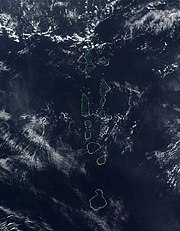
Maldives, officially the Republic of Maldives, is an island nation consisting of a group of atolls in the Indian Ocean. The Maldives are located south of India's Lakshadweep islands, and about seven hundred kilometers (435 mi) south-west of Sri Lanka. The twenty-six atolls encompass a territory featuring 1,192 islets, roughly two hundred of which are inhabited by people. The country's name may stand for "Mountain Islands" (malai in Tamil, meaning "mountain" and teevu in Tamil meaning "island") or it may mean "a thousand islands". Some scholars believe that the name "Maldives" derives from the Sanskrit maladvipa, meaning "garland of islands", or from "mahila dvipa", meaning "island of women". Others believe the name means "palace" (from Mahal in Arabic).
Following the introduction of Islam in 1153, the islands later became a Portuguese (1558), Dutch (1654), and British (1887) colonial possession. In 1965, Maldives obtained independence from Britain (originally under the name "Maldive Islands"), and in 1968 the Sultanate was replaced by a Republic. However, in 38 years, the Maldives have had only two Presidents, though political restrictions have loosened somewhat recently.
Maldives is the smallest Asian country in terms of population. It is also the smallest predominantly Muslim nation in the world.


History

Western interest in the archaeological remains of early cultures on Maldives began with the work of H.C.P. Bell, a British commissioner of the Ceylon Civil Service. Bell was shipwrecked on the islands in 1879, and returned several times to investigate ancient Buddhist ruins.
By the fourth century AD, Theravada Buddhism came from Ceylon (present-day Sri Lanka) and became the dominant religion of the people of Maldives. Some scholars believe that the name "Maldives" derives from the Sanskrit maladvipa, meaning "garland of islands". Also "Mal" is fish "deeb" is land is also a favored suggestion by many islanders.
In the mid-1980s, the Maldivian government allowed the noted explorer and expert on early marine navigation, Thor Heyerdahl, to excavate ancient sites. Heyerdahl studied the ancient mounds, called hawitta (Dhivehi: ހަވިއްތަ) by the Maldivians, found on many of the atolls. Some of his archaeological discoveries of stone figures and carvings from pre-Islamic civilizations are today exhibited in a side room of the small National Museum in Male'.
Heyerdahl's research indicates that as early as 2000 BC, Maldives lay on the maritime trading routes of early Egyptian, Mesopotamian, and Indus Valley civilizations. Heyerdahl believes that early sun-worshipping seafarers, called the Redin, first settled on the islands. This was evident then in many mosques facing the sun and not Mecca, lending credence to this theory. Because building space and materials were scarce, successive cultures constructed their places of worship on the foundations of previous buildings. Heyerdahl thus surmises that these sun-facing mosques were built on the ancient foundations of the Redin culture temples. Heyerdahl's early mosques have now in large part been converted to face Mecca, as Islam gained solidarity in Maldives, in the earlier half of the modern Republic.
According to Maldivian legend, a Sinhalese prince named Koimala was stranded with his bride – daughter of the king of Sri Lanka – in a Maldivian lagoon and stayed on to rule as the first sultan from the House of Theemuge. Prior to that Malé had belonged to a group of people today known as the Giravaaru who claim ancestry from ancient Tamils (Tamilas).
The Maldivians followed Buddhism before they converted to Islam and the conversion is explained in a controversial mythological story about the demon Rannamaari.
Over the centuries, the islands have been visited and their development influenced by sailors from countries on the Arabian Sea and the Indian Ocean littorals. Mappila pirates from the Malabar Coast – present-day Kerala state in India – harassed the islands.
Although governed as an independent Islamic sultanate for most of its history from 1153 to 1968, Maldives was a British protectorate from 1887 until July 25, 1965. In 1953, there was a brief, abortive attempt to form a republic, but the sultanate was re-imposed. In 1959, objecting to Nasir's changes, the inhabitants of the three southernmost atolls protested against the government. They formed the United Suvadive Republic and elected a president, Abdulla Afeef Didi.
After independence from Britain in 1965, the sultanate continued to operate for another three years. On November 11, 1968, it was abolished and replaced by a republic, and the country assumed its present name. Tourism and fishing are now being developed on the archipelago.
In November 1988, Tamil mercenaries from Sri Lanka invaded the Maldives. After an appeal by the Maldivian government for help, India launched a military campaign to throw the mercenaries out of Maldives. On the night of November 3, 1988, the Indian Air Force airlifted a parachute battalion group from Agra and flew them non-stop over 2,000 kilometres (1,240 mi) to Maldives. The Indian paratroopers landed at Hulule and secured the airfield and restored the Government rule at Malé within hours. The brief, bloodless operation, labelled Operation Cactus, also involved the Indian Navy.
On 26 December 2004 the Maldives were devastated by a tsunami following the 2004 Indian Ocean earthquake. Only 9 islands were reported to have escaped any flooding, while 57 islands faced serious damage to critical infrastructure, 14 islands had to be totally evacuated, and 6 islands were decimated. A further 21 resort islands were forced to shut down due to serious damage. The total damage was estimated at over 400 million dollars or some 62% of the GDP. A total of 108 people, including 6 foreigners, reportedly died in the tsunami. The destructive impact of the waves on the low-lying islands was mitigated by the fact there was no continental shelf or land mass upon which the waves could gain height. The tallest waves were reported 14 feet high.

Labels: , , , , , , , ,


Image Hosted by ImageShack.us


WEATHERForecast: 15-Day Overview
Google

Archives


I NEED A VOCATION Maldives Welcome to Maldives A little bit of Maldives maldives sky map Maldives Part One Maldives Part Two VOCATION IN PARADİSE
Live Flight Information


google adwords reklam Super Bowl 2010 Live