MALDIVES ONLiNE <body><script type="text/javascript"> function setAttributeOnload(object, attribute, val) { if(window.addEventListener) { window.addEventListener('load', function(){ object[attribute] = val; }, false); } else { window.attachEvent('onload', function(){ object[attribute] = val; }); } } </script> <div id="navbar-iframe-container"></div> <script type="text/javascript" src="https://apis.google.com/js/platform.js"></script> <script type="text/javascript"> gapi.load("gapi.iframes:gapi.iframes.style.bubble", function() { if (gapi.iframes && gapi.iframes.getContext) { gapi.iframes.getContext().openChild({ url: 'https://www.blogger.com/navbar/2565417034522534591?origin\x3dhttp://maldives-online.blogspot.com', where: document.getElementById("navbar-iframe-container"), id: "navbar-iframe" }); } }); </script> SCREEN RESOLUTION HAS TO BE 1152*864


<$Saturday, November 17, 2007h5>
<$

North Ari Atoll

Hotel Description:

Ellaidhoo Maldives is a magnificent coral island with sugary white beaches, lush green vegetation, warm seas and hospitable ambience. The island along with resort promises efficient services, friendly crews and perfect serenity.

Ellaidhoo is very popular amongst divers and large number of guests who visit every year. Around this tiny paradise is a beautiful coral reef, and the wreck just below the edge of the house reef is hallmark amongst the divers who have visited Maldives.

Ellaidhoo provides excellent diving facilities with highly qualified professional instructors and is well known for diving. One could call it "The Divers' Paradise" being located amidst of famous dive sites. In addition to the comfortable beachfront rooms with all the modern facilities, it also provides a wide range of water sports and other activities.


How to get to the hotel? TOP

Ellaidhoo Maldives is located on the eastern fringes of North Ari Atoll, which is about 40-42 km from Male International Airport.

You can travel to Ellaidhoo from airport by a seaplane, which takes 20 minutes and speedboat, which takes 1 hour and 30 minutes to reach the island. Day and night transfers to the island are available.


Food and Beverages
The Food and Beverage outlets on Ellaidhoo offer a variety of local and international dishes.

Main Restaurant
The Food and Beverage outlets on Ellaidhoo offer a variety of local and international dishes.

Coffee Shop
The coffee shop with Internet is open from 9am in the morning until midnight and serves different hot and cold beverages, snacks, and various local and international dishes. Internet service is also available here at set times during the day.

Business Facilities
The business facilities in Ellaidhoo Resort are excellent. Thre facilities available allow one to work in a hassle free manner. There is a business center in this resort where one can avail of photocopying services, facsimile services and other services that are necessary to conduct office work and other business related work. There is a photocopying machine, which can be used to get photocopies of important documents.

Excursions
wind surfing, catamaran sailing, water skiing, jet skiing, knee boarding, wake boarding, banana riding and fun tube riding.

Main Bar
The main bar is open throughout the day from seven in the morning until the last guest leaves at night. A variety of exotic cocktails and alcoholic and non-alcoholic beverages are available.

Sports Center
.Gym Work out
.Aerobics
.Spinning Sauna & Jacuzzi
.Billiards
.Squash
.Tennis
.Table Soccer

Water Sports
Ellaidhoo Water Sports Centre is located in Maagaa island and offers:
.Wind surfing
.Catamaran sailing
.Water skiing
.Jet skiing
.Knee boarding
.Wake boarding
.Banana riding
.Fun tube riding.


Hotel Rooms:

Ellaidhoo Resort offers 78 modern luxury rooms in the island are all built along the beach facing the magnificent house reef. The rooms have been categorized in to Standard, Superior and Deluxe rooms suiting the needs and requirements of the guests.

In-Room Amenities
.Air-conditioning
.En-suite toilet
.Shower with hot and cold water
.Mini-bar
.Hairdryer
.IDD telephone.


Hotel Terms and conditions: TOP

Currency
All rates shown are in US $.

Package Includes
-All rates shown are per room/suite and include all taxes.

Mandatory Handling Fee
A mandatory handling fee of USD 10.00 per person and to be added on top of the quoted price.

Payment Requirements
For your convenience, Internet Travel Group offers secure online payments with the following credit cards: Visa, Mastercard and American Express. Please note that, should you prefer, you are able to supply your credit card information by fax. We are unable to accept your reservation request without credit card details, though you will only be billed once your booking has been confirmed, the credit card information verified and our confirmation voucher sent to you by email.

For all reservations
-The full amount will be charged at the moment of confirmation.

Cancellation Policy
.If cancellation is received 16 days or more prior to arrival, then 20% of the full amount will b e lost.
.If cancellation is received 15 days prior to client’s arrival, then 50% of the total cost for the stay will be charged.
.No show will result on the full amount being charged as a cancellation fee.

Children Policy
.Children over the age of 12 are considered as adult.
.Children requiring their own room are charged as adult.
.Children's rate are available upon request.

Transfer
-Return seaplane transfer will come at a rate of USD250.00 per adult and children will get a 50% of the rate.

Labels: , , , , ,

<$Friday, March 23, 2007h5>
<$


Island summary
Belongs to Kaafu Atoll
Location 4°10′N 73°30′E
Population 81,647 (2004)
Length 1.7 km / 1.05 miles
Width 1.0 km / 0.62 miles

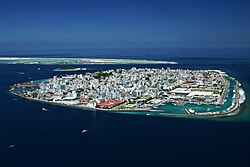
Malé (Dhivehi: މާލެ), (pronounced: "Maa-lay") population 81,647 (2004), is the capital of the Republic of Maldives. The city is located on Malé Island in the Kaafu Atoll. Although Malé is geographically located in Kaafu Atoll, administratively it is not considered part of it. A commercial harbour is located in the Island. It is the heart of all commercial activities in the country. Many government buildings and agencies are located on the waterfront. Malé International Airport is on adjacent Hulhule Island which includes a seaplane base for internal transportation. Several land reclamation projects have expanded the harbour. Malé is located at 4°10' North, 73°30' East (4.1667, 73.5).

The town of Malé was founded by Portuguese traders in the 16th century.

The island is heavily urbanised, the city taking up essentially its entire landmass. It is the world's most densely populated city (see list of selected cities by population density). Slightly less than one third of the nation's population lives in the capital city. Many, if not most, Maldivians and foreign workers in Maldives find themselves in occasional short term residence on the island due to it being the only entry point to the nation and the centre of all administration and bureaucracy.

The town is divided into four divisions; Henveiru, Galolhu, Maafannu and Machangolhi. Male'viligili (a near by island) is the fifth division considered by the government.

Malé was struck by the tsunami that swept across the western coast of Sumatra on December 26, 2004. It was affected by the Indian Ocean earthquake which followed with the waves flooding two-thirds of the city. The earthquake and subsequent tsunamis reportedly killed over 220,000 people around the rim of the Indian Ocean.

The name
The name Malé is taken from the word "Mahaalay" which has come from the Sanskrit language. The name is derived from maha, meaning "big" or "great" and aalay meaning house. Generally the word Mahaalay is used for the palace of a king or capital (king's island) in Sanskrit, e.g. Mahaalay of King Asok

Labels: , , , , , , , ,

<$


LOCATION

The Maldives is the best-kept secret of the Indian Ocean, 'paradise lost' waiting to be rediscovered. The 26 atolls and 1,190 beautiful sun-kissed islands south of Sri Lanka are nothing short of a natural wonder with their untouched Eco-systems and unparalleled bio-diversity. With over 900 species of fish, the Maldives boasts some of the most breathtaking dive sites in the world.Occupying the entire island of Vabbinfaru, the jewel of the North Malé Atoll, Banyan Tree Maldives Vabbinfaru lies in secluded luxury, yet merely 20 minutes by speedboat from the airport and Malé, the capital of the Maldives. Surrounded by dazzling white talc sand and the bluest of waters teeming with an astonishing abundance of soft corals and fish sparkling in brilliant colors, the exquisite beauty of this tropical haven is all yours. The beaches and surrounding waters remain accessible only to our guests.


ACCOMMODATION


Vabbinfaru Villa
Stay at the lavish Vabbinfaru Villa for an extravagant beach hideaway with a personal touch, including a chilled bottle of champagne upon arrival. Enjoy the luxury of a large landscaped garden with ocean views, al fresco living pavilion, beach ‘sala’ pavilion, sundeck, Jacuzzi and outdoor shower. Families can opt for two or three inter-connecting Deluxe Beachfront Villas. Ample space makes the Vabbinfaru Villa ideal for small wedding parties; yet, priceless privacy can be found within each villa. Sit back and let the shooting stars fall into your lap.

Deluxe Beachfront Villa
The natural beauty of Vabbinfaru Island can now be experienced in the plush comfort of the new Deluxe Beachfront Villa. The stylish interior has been designed to be bright and breezy – it opens on to a large sundeck at the front that leads to the powder-soft beach and into a glitzy bathroom at the back with an outdoor Jacuzzi and garden shower. Here you can take part in the play of nature and count the hues of the changing sky, as the stunning sunrise, sunset and star-filled night sky leave their shimmering reflections on the lagoon.

Deluxe Oceanview Villa
The new Deluxe Oceanview Villa invites you to relish the heavenly tranquility of an enchanting garden from your own pavilion. While featuring the same facilities and comfort as a Deluxe Beachfront Villa, the secluded garden setting of the new Deluxe Oceanview Villa is much treasured for its generous space, privacy and shady greenery. The beach peeps through the leaves and entices you to soak up a golden tan, laze around and see your footsteps disappear in the sand as the winds blow from the sea. A heavenly place to pamper yourself with an in-villa BBQ or soothing massage.

Beachfront Villa
With its private outdoor Jacuzzi and sundeck by the beach, the Beachfront Villa is ideally suited for a romantic getaway. Watch the spectacular ocean vista unfold from the terrace, while the balmy sea breeze cools the room. Or step onto the silky sand of the beach and swim above the virtually untouched house reef with its glorious display of color and the occasional trumpet fish, harmless baby shark and turtle.

Oceanview Villa
The Oceanview Villa delivers unparalleled privacy with its very own open-air Jacuzzi on a wooden patio and a sala (pavilion) in the walled garden. Relax under the shade of the pavilion while sipping your cocktail. Immerse yourself in the bubbling waters of the Jacuzzi and feel the tension seep away from your body as you drift off to the sound of waves lapping on the picture-perfect shores.


DINING AND BARS


Day or night, wining and dining in the breathtaking natural beauty of the Maldives is simply unforgettable. A romantic experience you will cherish forever. Banyan Tree Maldives Vabbinfaru offers excellent dining choices ranging from eclectic Maldivian and International cuisine at Ilaafathi restaurant to candlelit dinners under the stars. You can be sure that the cuisine is delectable, the setting exquisite and the atmosphere awe-inspiring. Bon Appetit or Ufaaveri Keumeh, as they say in Dhivehi.

Ilaafathi Restaurant
Tuck into scrumptious Maldivian and International treats in the casual setting of Ilaafathi restaurant. Set right on the beach with a natural Alang-Alang roof, this beachfront eatery serves extravagant buffet breakfasts and superb set dinners that will make you come back for more.

Naiboli Bar
Appetizing snacks are served all day long at our open-air Naiboli Bar, along with your favorite cocktails. You can while away many happy hours here chatting with friends, having a game of snooker, or simply unwinding in the warm and friendly atmosphere. Perfect for a light appetite in the middle of the day.

Private Dining
Fancy having a wildly romantic candlelit barbecue dinner in the intimacy of your villa or by the beach? We'll arrange that for you and even provide you with your very own private chef and waiter. Spoilt by our attentive service and fine cuisine, you will feel pampered like royalty.

Sandbank Dining
Have you ever dreamt of sweeping your loved one off the feet with a romantic dinner that is out of this world? Let your imagination run wild and we'll make your dreams come true by taking you to a stunning sandbank by speedboat. The breathtaking view of the sun setting over the Indian Ocean will whet your appetite, revealing the magical night sky of a billion stars and the hypnotic melody of the ocean. Once ushered to a table of gourmet victuals and champagne, with only the moon and torches lighting your feast, the universe is reduced to just the two of you. What a wonderful way to start the evening. Simply perfect.


RECREATION


If you venture beyond the pampered realm of your villa and the wonderfully slow Maldivian pace of life, you'll find a wealth of recreational diversions. For a start, you can dive or snorkel in the transparent brilliance of the ocean, explore its riches, and go deep-sea or night fishing. After all, this is a paradise renowned for superlative fishing, sailing, diving and snorkeling. If you prefer, sit in the shallow waters and watch the myriad of exotic schools of fish dart in and out of the light, or go kite flying with the clear blue sky as the backdrop.

Then, there are ball and racket games you can play with your partner. For more vigorous workouts, head for the resort's health club. And for the less actively inclined, a ramble around Malé exploring its sights and shopping, or a promenade along the beach are just as rousing. If the sun gets to you, simply retire to the resort's TV room for board games or some quiet reading.

- Water sports facilities: snorkeling, PADI dive center, deep-sea fishing, night fishing, water-skiing, windsurfing,
catamaran sailing, canoeing and fun tubes
- Ball and racket games: beach volleyball, table tennis, snooker and badminton
- TV room with reading area and board games
- Underwater camera rental
- Health club
- Excursions: Malé sightseeing, island hopping, snorkeling safari, private yacht charter and sea plane trips.

Labels: , , , , , , , ,

<$

Bandos, a beautiful coral island located in North Malé’ Atoll, about 7 kilometres from Malé International Airport and the capital Malé, is covered with lush tropical vegetation, numerous palm trees, surrounded by a wide sandy beach and the crystal clear waters of an azure lagoon. The island owns one of the best house reefs, just 40 - 60 metres away from the beach. The natural splendor is complemented by the modern amenities of the resort, which ensure that your stay is both comfortable and memorable.

A major reconstruction project successfully completed in 2005 has brought a trendy new look to Bandos. Front desk, lobby areas, shops, all the restaurants, bars, and a new swimming pool have been rebuilt with the state of the art architectural designs blending perfectly with the tropical surrounding and maintaining the “local feel”. Rooms on the northern side of the island have been replaced by elegantly designed individual loft type Beach Villas with the most modern facilities and amenities.

Bandos has perfected its role of the “welcoming host” and can cater to every mood. The natural splendor is complemented by the modern amenities of the resort, which ensure that your stay is both comfortable and memorable.

ACCOMMODATION

Nature has created a perfect home away from home on Bandos. We offer you the comfort of modern living without diminishing the beauty of the natural surroundings. Bandos Island Resort has a total of 225 guestrooms discreetly tucked away in the lush tropical vegetation, spacious and airy. After a long day in the sun the cool comfort of your room is the ideal place to relax. The types of accommodation offered.

Standard Rooms
A total 103 Standard Rooms, conveniently located on the southern side of the island are all beach-fronted and in blocks of four rooms adjacent to each other. Facilities include: double/twin bed, tiled floor, mini bar, International Direct Dial telephone, air-conditioning, beach beds with beach chairs, bathroom with shower, hot & cold water, hair dryer, satellite television, tea/coffee making facilities and electronic safety deposit box.

Deluxe Rooms
48 Junior Suites are all beach-fronted and in blocks of two rooms each with inter-connecting doors and are more spacious with sitting/living area. Junior Suites are also ideal for families with small children as well as for the wheelchair-bound guests. Facilities include: double/twin bed (some rooms have four-poster beds), tiled floor, mini bar, International Direct Dial telephone, air-conditioning, beach beds with beach chairs, bathroom with shower, bath tub, hot & cold water, hair dryer, satellite television, tea/coffee making facilities and electronic safety deposit box.

DINING

Bandos Island Resort offers you six different culinary experiences, ranging from A La carte to set menus.

The Harbour
Dine with style in the newly built and elegantly designed fine dining restaurant - The Harbour. Here you will have options of dining either in air-conditioned comfort or while enjoying the cool breeze and the breathtaking scenery on the open air over water deck. The Harbour specialises in presenting you with the best of Maldivian fish, a large variety of seafood, home-made pasta and a selection of tender steaks char grilled to your taste. The silver light of the moon, the most delicious food and our warm and friendly staff make it one of the most memorable moments of your holiday.

Gallery Restaurant
The main restaurant of Bandos Island Resort is open for breakfast, lunch and dinner and specialises in catering for guests whose holiday package includes meals - yet is open to all the guests. Package holidaymakers, however, are not restricted to one restaurant, but are welcome to eat either at the Coffee shop or the Harbour Grill with a discount. • Breakfast: 0700 - 0945hrs. • Lunch: 1230 - 1400hrs. • Dinner: 1915 - 2130 hrs. On Fridays Lunch is served between 1300 - 1430hrs

HOTEL SERVICES

Within a few minutes you feel at home on this welcoming island and wonder what took you so long to discover this haven in the middle of the Indian Ocean.

Labels: , , , , , , , ,

<$Saturday, March 17, 2007h5>
<$
Fishing

Pole and Line Fishing
Since time immemorial, the method of fishing employed in the Archipelago has been the pole and line method. The types of fish caught by this method are tuna, skipjack tuna, frigate and mackerel. The main catch is tuna, which is used in the daily diet of the inhabitants, as well as for export in different forms. The daily catch depends for the most part on the seasons. Although triangular sailed dhoani, were used in the past, today fishing dhoanis are mechanized.

Traditionally, the fishermen set out at dawn in search of bait fish, which were caught and kept alive in a specially prepared compartment of the dhoani. Eight or nine men did the actual fishing. The poles are short, are equipped with a line, and hook. During a favorable season, the catch could be as much as a thousand fish per dhoani per day. Traditionally, the fishermen return to the island by nightfall however, with the advent of mechanized dhoani, they are back by early afternoon. Skipjack tuna and yellowfin tuna are the most common species caught in Maldives.


Industrial Fishing
Mechanization of the traditional sailing dhoani in 1974 revolutionized the fisheries industry of the Maldives. A new generation of dhoani, designed especially for mechanization was introduced. A fish-canning factory was set up in 1977 as a joint venture with a Japanese company. However, when the government took over the plant in 1982, it was unable to meet the overseas demand due to the poor condition of buildings and equipment, so a new factory was opened in 1986. In 1979, Maldives Nippon Corporation was formed, in partnership with the Marubeni Corporation of Japan, to process and can fresh tuna. In the same year, the Maldives Fisheries Corporation was formed to exploit fish wealth. (The MFC later became the Fisheries Projects Implementation Department (FPID), which was transformed into MIFCO in 1993).

When the Japanese pulled out, the government negotiated a deal to buy the three freezer and six collector vessels that belonged to them, which then became part of the State Trading Organization (STO) fleet. However, by the time that STO inherited the Japanese fleet; the vessels were over twenty years old. A new fleet of vessels was acquired. Three mother ships were built in Korea and nine collector vessels were constructed in Malé. A boat yard was built on the island of Alifushi and the construction of one hundred second-generation Mark II dhoanis was begun. These dhoanis were sold to the fishermen on a lease-purchase basis. The opening up of the exclusive economic zone (EEZ), for fisheries proved to be a boon to the country’s fishing industry.


Fish Cannery
The first fish canning plant was established on the island of Felivaru, as a joint venture with a Japanese firm, in 1977. In 1982, the government took over the cannery, but the condition of the original buildings, equipment seriously limited production, and the cannery was not able to meet the increasing demand of an expanding overseas market. In new cannery was opened 1986. The new Felivaru Tuna Processing Plant has its own electricity, a desalination plant, water storage tanks and ice making plant. While this 150,000 cans per hour plant increased production, it was still unable to meet the rising overseas demand for Maldive tuna.


Tourism

Development
White sandy beaches, clear waters, and waving palms under blue skies make Maldives a tourist destination. Tourism was introduced to the Maldives in the early 1970s. The first two resort islands had a capacity of 280 beds. The first tourists arrived mostly as individuals or small groups. Soon, Maldives began to be recognized as an international tourist destination.

In 1972 the first tourist resort, Kurumba Village, (today a five star hotel), was pioneered by two Maldivian entrepreneurs in association with an Italian investor. A second resort was opened the same year on the island of Bandos. Despite the basic facilities and services, 1,096 tourist arrivals were recorded that year.

At the start, the country’s tourism and its development was for the most part dependent on private initiative. In 1979, the tourism law was enacted, requiring all foreign investments to be registered at the Department of Tourism and Foreign Investment. A tourism master plan was formulated in 1983, setting up guidelines for the overall development of tourism, and identifying tourism zones in different parts of the country. In 1984, the tourism advisory board was created. The department of tourism was upgraded to a ministry in 1988.

The opening of Malé International Airport in 1981 was an important milestone in the travel business. At the early stages, tourism in Maldives was a seasonal industry. As the country opened up further, this seasonal nature of tourism changed. In the early 21st century tourist arrivals were recorded throughout the year. During 1987, a school of hotel and catering was established to meet the manpower requirements of the industry. Both government and private sector provide overseas training to those employed in the industry.

The private sector and the government are actively involved in the promotion and marketing of the tourism product. Maldives is represented in all major international travel fairs by both the government and the private operators. The tourist information counter at the Malé International Airport hands out leaflets and other information about the country. The Tourist Information Unit was formed in 1989 to further disseminate information.

The development of tourism has fostered the overall growth of the country’s economy. It has created direct and indirect employment and income generation opportunities in other related industries. Today, tourism is the country’s biggest foreign exchange earner, contributing nearly a fifth of the GDP.

With 86 tourist resorts in operation, the year 2000 recorded 467,154 tourist arrivals.


Tourist Facilities
Each tourist resort is situated on an uninhabited island. The islands are self-contained, with its own electricity, water and waste disposal facilities. The islands are developed according to the standards and guidelines set by the ministry of tourism. While all modern facilities are available, the islands retain its unique natural beauty. The designs feature local architectural concepts as well as international style. A variety of services and facilities are available to guests, to make visits comfortable, pleasant and memorable.


Maldives Tourism Promotion Board
The Maldives Tourism Promotion Board was established by the government to promote quality and sustainable growth in the country’s tourism industry and to foster a well utilized and financially healthy private sector industry. - in this way enabling the industry to deliver long term economic, social and cultural benefits to the people of Maldives, whilst at the same time contributing to enhancements in Maldives’ marine environment to the benefit of the people and visitors of the Maldives.


MATI
Maldives Association of Tourism Industry (MATI) is a non-profit non-governmental organization working towards the sustainable development of the country’s tourism industry. Its membership is open to those engaged in the travel trade business. MATI coordinates its activities with the government and work in partnership with other national and international organizations.

Labels: , , , , , ,

<$
Boli
Cowry shells (Cypraea moneta), or boli, were the first known medium of exchange used in the Maldives. Various writers and travellers have in the past recorded the country’s trade in these money shells, which were used as a medium of exchange in parts of Asia and Africa. In the past, cowry were actually cultivated in the Maldives. When Moroccan traveler and historian Ibn Battuta visited there in the 14th century, the Maldives was trading extensively with the money shells. The shells were also used to make ornaments. The country’s trade in cowry shells, which attracted the particular attention of the Dutch in Ceylon, continued until the late 19th century, when it was used mostly as ballast for sailing vessels.


Dhigu laari
According to history, the first dhigu laari was struck in the Maldives, during the reign of Sultan Ibrahim III ibn Ghazi Muhammed (1585-1607), son of the hero Sultan Ghazi Muhammed Thakurufa'anu Akbar al-'Azam. Dhigu laari or larin, which owes its name to Lar, in the Persian Gulf, where it was originally struck, was one of the standard currencies of the Indian Ocean in the late 16th century. The dhigu laari is actually a long piece of silver, about three inches in length, doubled over and stamped with the name of the sultan, in Arabic.


Loa laari
Loa laari or laari fothi ("circular coin") was first struck by Sultan Ibrahim Iskandar I (1648-1687). The first coins were of silver and fairly coarse. Later, coins of copper and lead were put in to circulation. Gold coins were also struck by Sultan Hassan Nooraddin (1779-1799). Said to be the finest struck at the Maldive mint, the two denominations of gold coins issued by Sultan Hassan Nooraddin, known as the mohori and bai mohori, were never put into circulation.


Today
The Maldivian unit of currency is the rufiyaa (ISO 4217 code MVR, symbol Rf.), introduced in 1981. The rufiyaa is divided into 100 laari. On 21 September 2005, the exchange rate with the US dollar was USD1.00 = MVR12.80.

Labels: , , , , , , ,

<$
The Maldivian ethnic identity is a blend of the cultures reflecting the peoples who settled on the islands, reinforced by religion and language. The earliest settlers were probably from Southern India. Indo-Aryan speakers followed them from Sri Lanka in the fourth and fifth centuries. In the 12th century, sailors from the Malayan Archipelago, East Africa and Arab countries inhabited the islands, creating the present heterogeneous blend of ethnicity amongst Maldivians.

Originally Buddhist[3], Maldivians were converted to Sunni Islam in the mid-twelfth century. Islam is the official religion of the entire population, as adherence to it is required for citizenship.

The official and common language is Dhivehi, an Indo-European language related to Sinhalese, the language of Sri Lanka. The written script is called Thaana and is written from right to left. English is used widely in commerce and increasingly as the medium of instruction in government schools.

Some social stratification along lines similar to the Indian caste system exists on the islands. It is not rigid, since rank is based on varied factors, including occupation, wealth, Islamic virtue, and family ties. Members of the social elite are concentrated in Malé. Outside of the service industry, this is the only location where the foreign and domestic populations are likely to interact. The tourist resorts are not on islands where the natives live, and casual contacts between the two groups are discouraged.

Census has been recorded since 1905, which shows that the population of the country remained around 100,000 for the first 7 decades of the last century. Following independence in 1965, the health status of the population improved so much that the population doubled by 1978, and the population growth rate peaked at 3.4% in 1985. By 2005, the population had reached 300,000, although the census in 2000 showed that the population growth rate had declined to 1.9%. Life expectancy at birth stood at 46 years in 1978, while it has now risen to 72 years. Infant mortality has declined from 127 per thousand in 1977 to 12 today, and adult literacy stands at 99%. Combined school enrolment stands in the high 90s.

In addition to the ethnic Maldivians, more than 50 000 (2006 july ) foreign employees live in the country. They comprise mainly of people from the neighbouring South Asian countries of India, Sri Lanka, Bangladesh and Nepal.

Labels: , , , , , , , , ,

<$Friday, March 16, 2007h5>
<$Wednesday, March 14, 2007h5>
<$


Atoll Summary
Administrative name Vaavu Atoll
Atoll name Felidhu Atoll
Location 3° 41' N and 3° 13' N
Letter J
Abbreviation V (ވ)
Capital Felidhoo
Population 2144
No. of Islands 19
Inhabited Islands 5
Atoll Chief Ali Rasheed Abdul Rahman [1]
Inhabited Islands
Felidhoo Fulidhoo Keyodhoo Rakeedhoo Thinadhoo

Labels: , , , , , , ,

<$

Kaafu Atoll is an administrative atoll from the Maldives. This administrative atoll has four natural atolls collectively called the Malé Atoll: (from north to south) Kaashidhoo, Gaafaru, the North Malé Atoll and the South Malé Atoll.

Malé, capital of the Maldives is located within the North Malé atoll.

Atoll Summary
Administrative name Kaafu Atoll
Atoll name Malé Atoll
Location 4°25′N 73°30′ECoordinates: 4°25′N 73°30′E
Letter H
Abbreviation K (ކ)
Capital Thulusdhoo
Population 9886
No. of Islands 107
Inhabited Islands 9
Atoll Chief Mohamed Adam [1]
Inhabited Islands
Dhiffushi Gaafaru Gulhi Guraidhoo Himmafushi Hulhumalé Huraa Kaashidhoo Malé Maafushi Thulusdhoo
Uninhabited Islands
Aarah Akirifushi Asdhoo Baros Biyaadhoo Bodubandos Bodufinolhu Boduhithi Boduhuraa Bolifushi Dhigufinolhu Dhoonidhoo Ehrruh-haa Enboodhoo Enboodhoofinolhu Eriyadhoo Farukolhufushi Feydhoofinolhu Fihalhohi Funadhoo Furan-nafushi Gasfinolhu Giraavaru Girifushi Gulheegaathuhuraa Helengeli Henbadhoo Hulhulé Huraagandu Ihuru Kagi Kalhuhuraa Kandoomaafushi Kanduoih-giri Kanifinolhu Kanuhuraa Kudabandos Kudafinolhu Kudahithi Kudahuraa Lankanfinolhu Lankanfushi Lhohifushi Lhosfushi Maadhoo Madivaru Mahaanaélhihuraa Makunudhoo Makunufushi Maniyafushi Medhufinolhu Meerufenfushi Nakachchaafushi Olhahali Olhuveli Oligandufinolhu Ran-naalhi Rasfari Thanburudhoo Thilafushi Thulhaagiri Vaadhoo Vaagali Vabbinfaru Vabboahuraa Vammaafushi Velassaru Velifaru Veliganduhuraa Vihamanaafushi Villingili Villingilimathidhahuraa Villingilivau Ziyaaraiffushi

Labels: , , , , , , , , , ,

<$


Raa Atoll is an atoll from the Maldives. The capital of Raa atoll is Ungoofaaru. Recently, the island has been reclaimed up to the edge of the reef in order to provide land for social and economic activities for the growing population.

The main tourist resort island on the Raa atoll is Meedhupparu

Administrative name Raa Atoll
Atoll name Maalhosmadulu
Location 5° 58' N and 5° 20' N
Letter E
Abbreviation R (ރ)
Capital Ungoofaaru
Population 19003
No. of Islands 88
Inhabited Islands 15
Atoll Chief Saud Abdulla
Inhabited Islands
Alifushi Angolhitheemu Fainu Hulhudhuffaaru Inguraidhoo Innamaadhoo Kandholhudhoo Kinolhas Maakurathu Maduvvaree Meedhoo Rasgetheemu Rasmaadhoo Ungoofaaru Vaadhoo

Labels: , , , , , , , , , ,

<$Sunday, March 11, 2007h5>
<$
An atoll is a type of low, coral island found in tropical oceans and consisting of a coral-algal reef usually surrounding an interior body of water called a lagoon. Atolls generally mark the locations of subsided (or sunken) extinct volcanic islands; the shape of the atoll is determined by the initial coastline of the original volcanic island, and is maintained so long as coral growth is faster than subsidence, and is not disturbed by other factors. Some atolls contain volcanic remnant islands at their centers. An atoll's low coral-sand islands form as a result of wave action breaking off pieces of coral at the reef escarpment and piling them up behind.

Usage

The word atoll comes from the Dhivehi (an Indo-Aryan language spoken on the Maldive Islands) word atholhu (Dhivehi: އަތޮޅު). Its first recorded use in English was in 1625. However, the term was popularised by Charles Darwin (1842, p. 2), who described atolls as a subset in a special class of islands, the unique property of which is the presence of an organic reef. More modern definitions of atoll are those of McNeil (1954, p. 396) as "...an annular reef enclosing a lagoon in which there are no promontories other than reefs and [islets] composed of reef detritus" and Fairbridge (1950, p. 341) "...in an exclusively morphological sense, [as] ...a ring-shaped ribbon reef enclosing a lagoon in the center."

Formation

This animation shows the dynamic process of coral atoll formation. Corals (represented in tan and purple) settle and grow around an oceanic island, forming a fringing reef. In favorable conditions, the reef will expand, and the interior island will subside. Eventually the island completely subsides beneath the water, leaving a ring of growing coral with an open lagoon in its center. The process of atoll formation may take as long as 30 million years to occur.Darwin published an explanation for the creation of coral atolls in the South Pacific (1842) based upon observations made during a five-year voyage aboard the HMS Beagle (1831–1836). His explanation, which is accepted as basically correct, involved considering that several tropical island types—from high volcanic island, through barrier reef island, to atoll—represented a sequence of gradual subsidence of what started as an oceanic volcano. He reasoned that a fringing coral reef surrounding a volcanic island in the tropical sea will grow upwards as the island subsides (sinks), eventually becoming a barrier reef island (as typified by an island such as Bora Bora and others in the Society Islands). The fringing reef becomes a barrier reef for the reason that the outer part of the reef maintains itself near sea level through biotic growth, while the inner part of the reef falls behind, becoming a lagoon because conditions are less favorable for the corals and calcareous algae responsible for most reef growth. In time, subsidence carries the old volcano below the ocean surface, but the barrier reef remains. At this point, the island has become an atoll.

Atolls are the product of the growth of tropical marine organisms, so these islands are only found in warm tropical waters. Volcanic islands located beyond the warm water temperature requirements of reef building (hermatypic) organisms become seamounts as they subside and are eroded away at the surface. An island that is located where the ocean water temperatures are just sufficiently warm for upward reef growth to keep pace with the rate of subsidence is said to be at the Darwin Point. Islands more polar evolve towards seamounts or guyots; islands more equatorial evolve towards atolls (see Kure Atoll).

Reginald Aldworth Daly offered a somewhat different explanation for atoll formation: islands worn away by erosion (ocean waves and streams) during the last glacial stand of the sea of some 300 feet below present sea level, developed as coral islands (atolls) (or barrier reefs on a platform surrounding a volcanic island not completely worn away) as sea level gradually rose from melting of the glaciers. Discovery of the great depth of the volcanic remnant beneath many atolls (see Midway Atoll), favors the Darwin explanation, although there can be little doubt that fluctuating sea level has had considerable influence on atoll and other reefs.


Distribution and size

Portion of a Pacific atoll showing two islets on the ribbon or barrier reef separated by a deep pass between the ocean and the lagoon.
An atoll in the western Pacific OceanThe distribution of atolls around the globe is instructive: most of the world's atolls are in the Pacific Ocean (with concentrations in the Tuamotu Islands, Caroline Islands, Marshall Islands, Coral Sea Islands, and the island groups of Kiribati and Tuvalu) and Indian Ocean (the Maldives, the Laccadive Islands, the Chagos Archipelago and the Outer Islands of the Seychelles). The Atlantic Ocean has no large groups of atolls, other than eight atolls east of Nicaragua that belong to the Colombian department of San Andres and Providencia.

As noted above, reef-building corals can thrive only in warm tropical and subtropical waters of oceans and seas, and therefore atolls are only found in the tropics and subtropics. The northernmost atoll of the world is Kure Atoll at 28°24' N, along with other atolls of the Northwestern Hawaiian Islands. The southernmost atolls of the world are Elizabeth Reef at 29°58' S, and nearby Middleton Reef at 29°29' S, in the Tasman Sea, both of which are part of the Coral Sea Islands Territory. The next southerly atoll is Ducie Island in the Pitcairn Islands Group, at 24°40' S. Bermuda is sometimes claimed as the "northernmost atoll" at a latitude of 32°24' N. At this latitude coral reefs would not develop without the warming waters of the Gulf Stream. However, Bermuda is what is termed a pseudo-atoll because its general form, while resembling that of an atoll, has a very different mode of formation. While there is no atoll directly on the Equator, the closest atoll to the Equator is Aranuka of Kiribati, with its southern tip just 12 km North of the Equator.

In terms of total area (lagoon plus reef), the largest atolls are found in the Maldives: Huvadhoo Atoll, having an area of 2800 (or 3200?) km²; the area of Thiladhunmathi and Miladhunmadulu Atolls (two names, but a single atoll structure) is even larger at 3680 km². Another large atoll is Lihou Reef in the Coral Sea, with a lagoon of 2,500 km². However, by far the largest atoll structure of the world is the Great Chagos Bank in the Indian Ocean, a mostly submerged atoll, part of the Chagos Islands, with an area of roughly 13,000 km². If Saya de Malha Bank were to be recognized as a wholly submerged atoll structure, it would be the world's largest, at 40,000 km². Kwajalein in the Marshall Islands, which is sometimes listed as the largest atoll of the world (largest in the Pacific), measures only 846 km², by contrast. Large atolls are also found in the Tuamotu Archipelago, the largest being Rangiroa, with a lagoon area of 1018 km².

In most cases, the land area of an atoll is very small in comparison to the total area. The largest atoll in the world in terms of "land area" (land "permanently" above sea level) is Kiritimati (321.37 km² land area; according to other sources even 575 km²), 160 km² main lagoon, 168 km² other lagoons (according to other sources 319 km² total lagoon size). If the Caicos Islands are to be considered a huge coral atoll, with the Caicos Bank as a lagoon, this complex would be the largest atoll in land area (460.2 km²) and second largest in total area (lagoon size roughly 3,700 km²).

Labels: , , , , , , , , , ,

<$
Politics in the Maldives takes place in the framework of a presidential republic, whereby the President is the head of government. The President heads the executive branch and appoints the cabinet. The President is nominated to a five-year term by a secret ballot of the Majlis (parliament), a nomination which must be confirmed by national referendum.

The unicameral Majlis of the Maldives is composed of fifty members serving five-year terms. Two male members from each atoll are elected directly by universal suffrage. Eight are appointed by the president, which is the main route through which women enter parliament. The country introduced political parties for the first time in its history in July 2005, six months after the last elections for the parliament. Nearly 36 members of the existing parliament joined the Dhivehi Raiyyathunge Party (which translates to Maldivian People's Party) and elected President Gayoom as its leader. Twelve members of parliament became the Opposition and joined the Maldivian Democratic Party. Two members remained independent. In March 2006, President Gayoom published a detailed Roadmap for the Reform Agenda, providing time-bound measures to write a new Constitution, and modernise the legal framework. Under the Roadmap, the government has submitted to the Parliament a raft of reform measures. The most significant piece of legislation passed so far is the Amendment to the Human Rights Commission Act, making the new body fully compliant with the Paris Principles.

The 50 members of parliament sit with an equal number of similarly constituted persons and the Cabinet to form the Constitutional Assembly, which has been convened at the initiative of the President to write a modern liberal democratic constitution for the Maldives. The Assembly has been sitting since July 2004, and has been widely criticised for making very slow progress. The Government and the Opposition have been blaming each other for the delays, but independent observers attribute the slow progress to weak parliamentary traditions, poor whipping (none of the MPs were elected on a party ticket) and endless points of order interventions. Progress has also been slow due to the commitment of the main opposition party, MDP to depose President Gayoom by direct action ahead of the implementation of the reform agenda, leading to civil unrest in July-August 2004, August 2005 and an abortive putsch in November 2006. Significantly, the leader of the MDP, Ibrahim Ismail, MP for the biggest constituency, Male', resigned from his party post in April 2005 and eventually left MDP in November 2006 citing the intransigence of his own National Executive Committee. The government had engaged the services of a Commonwealth Special Envoy Tun Musa Hitham to facilitate all party dialogue, and when the MDP boycotted him, enlisted the services of the British High Commissioner to facilitate a dialogue. The ensuing Westminster House process made some progress but was abandoned as MDP called for the November revolution.

The call for an Orange Revolution on 10 November by MDP is seen as a mistake by many observers and even supporters, leading to fragmentation of the party and alienation of the members of the public. According to the registrar of parties, the DRP is the largest party in the country with over 35,000 card carrying members while the MDP, the second largest party, has 14,000.

The Roadmap provides the deadline of 31 May 2007 for the Assembly to conclude its work and to pave the way for the first multiparty elections in the country by October 2008.

On 19 June 2006, the Assembly voted to hold a public referendum to decide the form of government under the new constitutional settlement.

Labels: , , , , , , , , ,

<$Thursday, March 08, 2007h5>
<$

Maldives, officially the Republic of Maldives, is an island nation consisting of a group of atolls in the Indian Ocean. The Maldives are located south of India's Lakshadweep islands, and about seven hundred kilometers (435 mi) south-west of Sri Lanka. The twenty-six atolls encompass a territory featuring 1,192 islets, roughly two hundred of which are inhabited by people. The country's name may stand for "Mountain Islands" (malai in Tamil, meaning "mountain" and teevu in Tamil meaning "island") or it may mean "a thousand islands". Some scholars believe that the name "Maldives" derives from the Sanskrit maladvipa, meaning "garland of islands", or from "mahila dvipa", meaning "island of women". Others believe the name means "palace" (from Mahal in Arabic).
Following the introduction of Islam in 1153, the islands later became a Portuguese (1558), Dutch (1654), and British (1887) colonial possession. In 1965, Maldives obtained independence from Britain (originally under the name "Maldive Islands"), and in 1968 the Sultanate was replaced by a Republic. However, in 38 years, the Maldives have had only two Presidents, though political restrictions have loosened somewhat recently.
Maldives is the smallest Asian country in terms of population. It is also the smallest predominantly Muslim nation in the world.


History

Western interest in the archaeological remains of early cultures on Maldives began with the work of H.C.P. Bell, a British commissioner of the Ceylon Civil Service. Bell was shipwrecked on the islands in 1879, and returned several times to investigate ancient Buddhist ruins.
By the fourth century AD, Theravada Buddhism came from Ceylon (present-day Sri Lanka) and became the dominant religion of the people of Maldives. Some scholars believe that the name "Maldives" derives from the Sanskrit maladvipa, meaning "garland of islands". Also "Mal" is fish "deeb" is land is also a favored suggestion by many islanders.
In the mid-1980s, the Maldivian government allowed the noted explorer and expert on early marine navigation, Thor Heyerdahl, to excavate ancient sites. Heyerdahl studied the ancient mounds, called hawitta (Dhivehi: ހަވިއްތަ) by the Maldivians, found on many of the atolls. Some of his archaeological discoveries of stone figures and carvings from pre-Islamic civilizations are today exhibited in a side room of the small National Museum in Male'.
Heyerdahl's research indicates that as early as 2000 BC, Maldives lay on the maritime trading routes of early Egyptian, Mesopotamian, and Indus Valley civilizations. Heyerdahl believes that early sun-worshipping seafarers, called the Redin, first settled on the islands. This was evident then in many mosques facing the sun and not Mecca, lending credence to this theory. Because building space and materials were scarce, successive cultures constructed their places of worship on the foundations of previous buildings. Heyerdahl thus surmises that these sun-facing mosques were built on the ancient foundations of the Redin culture temples. Heyerdahl's early mosques have now in large part been converted to face Mecca, as Islam gained solidarity in Maldives, in the earlier half of the modern Republic.
According to Maldivian legend, a Sinhalese prince named Koimala was stranded with his bride – daughter of the king of Sri Lanka – in a Maldivian lagoon and stayed on to rule as the first sultan from the House of Theemuge. Prior to that Malé had belonged to a group of people today known as the Giravaaru who claim ancestry from ancient Tamils (Tamilas).
The Maldivians followed Buddhism before they converted to Islam and the conversion is explained in a controversial mythological story about the demon Rannamaari.
Over the centuries, the islands have been visited and their development influenced by sailors from countries on the Arabian Sea and the Indian Ocean littorals. Mappila pirates from the Malabar Coast – present-day Kerala state in India – harassed the islands.
Although governed as an independent Islamic sultanate for most of its history from 1153 to 1968, Maldives was a British protectorate from 1887 until July 25, 1965. In 1953, there was a brief, abortive attempt to form a republic, but the sultanate was re-imposed. In 1959, objecting to Nasir's changes, the inhabitants of the three southernmost atolls protested against the government. They formed the United Suvadive Republic and elected a president, Abdulla Afeef Didi.
After independence from Britain in 1965, the sultanate continued to operate for another three years. On November 11, 1968, it was abolished and replaced by a republic, and the country assumed its present name. Tourism and fishing are now being developed on the archipelago.
In November 1988, Tamil mercenaries from Sri Lanka invaded the Maldives. After an appeal by the Maldivian government for help, India launched a military campaign to throw the mercenaries out of Maldives. On the night of November 3, 1988, the Indian Air Force airlifted a parachute battalion group from Agra and flew them non-stop over 2,000 kilometres (1,240 mi) to Maldives. The Indian paratroopers landed at Hulule and secured the airfield and restored the Government rule at Malé within hours. The brief, bloodless operation, labelled Operation Cactus, also involved the Indian Navy.
On 26 December 2004 the Maldives were devastated by a tsunami following the 2004 Indian Ocean earthquake. Only 9 islands were reported to have escaped any flooding, while 57 islands faced serious damage to critical infrastructure, 14 islands had to be totally evacuated, and 6 islands were decimated. A further 21 resort islands were forced to shut down due to serious damage. The total damage was estimated at over 400 million dollars or some 62% of the GDP. A total of 108 people, including 6 foreigners, reportedly died in the tsunami. The destructive impact of the waves on the low-lying islands was mitigated by the fact there was no continental shelf or land mass upon which the waves could gain height. The tallest waves were reported 14 feet high.

Labels: , , , , , , , ,


Image Hosted by ImageShack.us


WEATHERForecast: 15-Day Overview
Google

Archives


I NEED A VOCATION Maldives Welcome to Maldives A little bit of Maldives maldives sky map Maldives Part One Maldives Part Two VOCATION IN PARADİSE
Live Flight Information


google adwords reklam Super Bowl 2010 Live